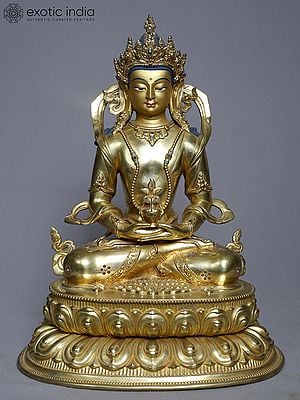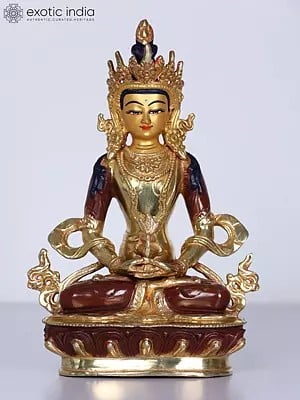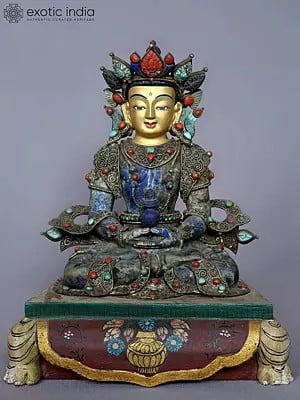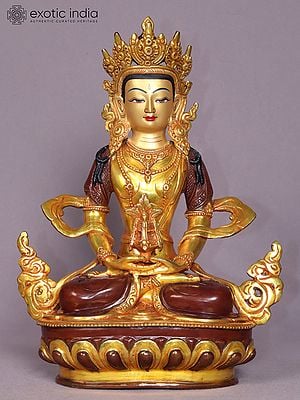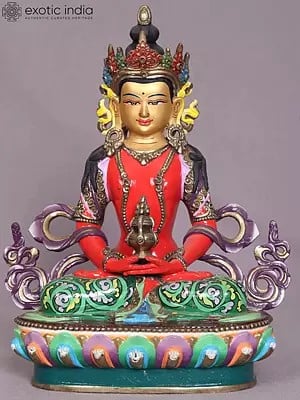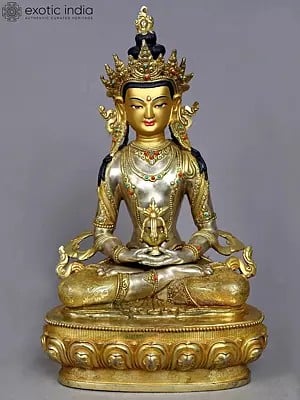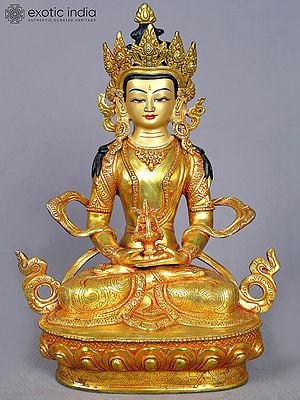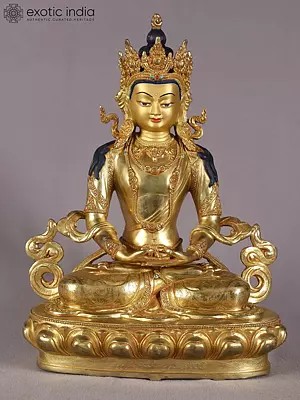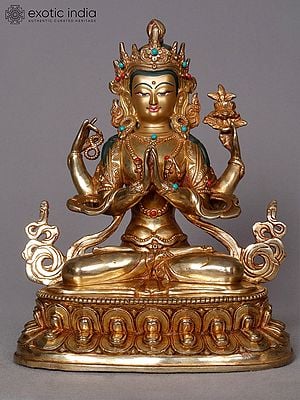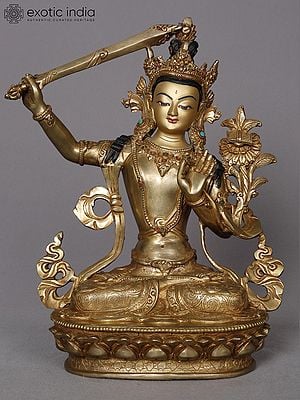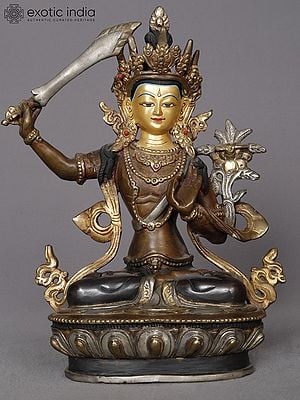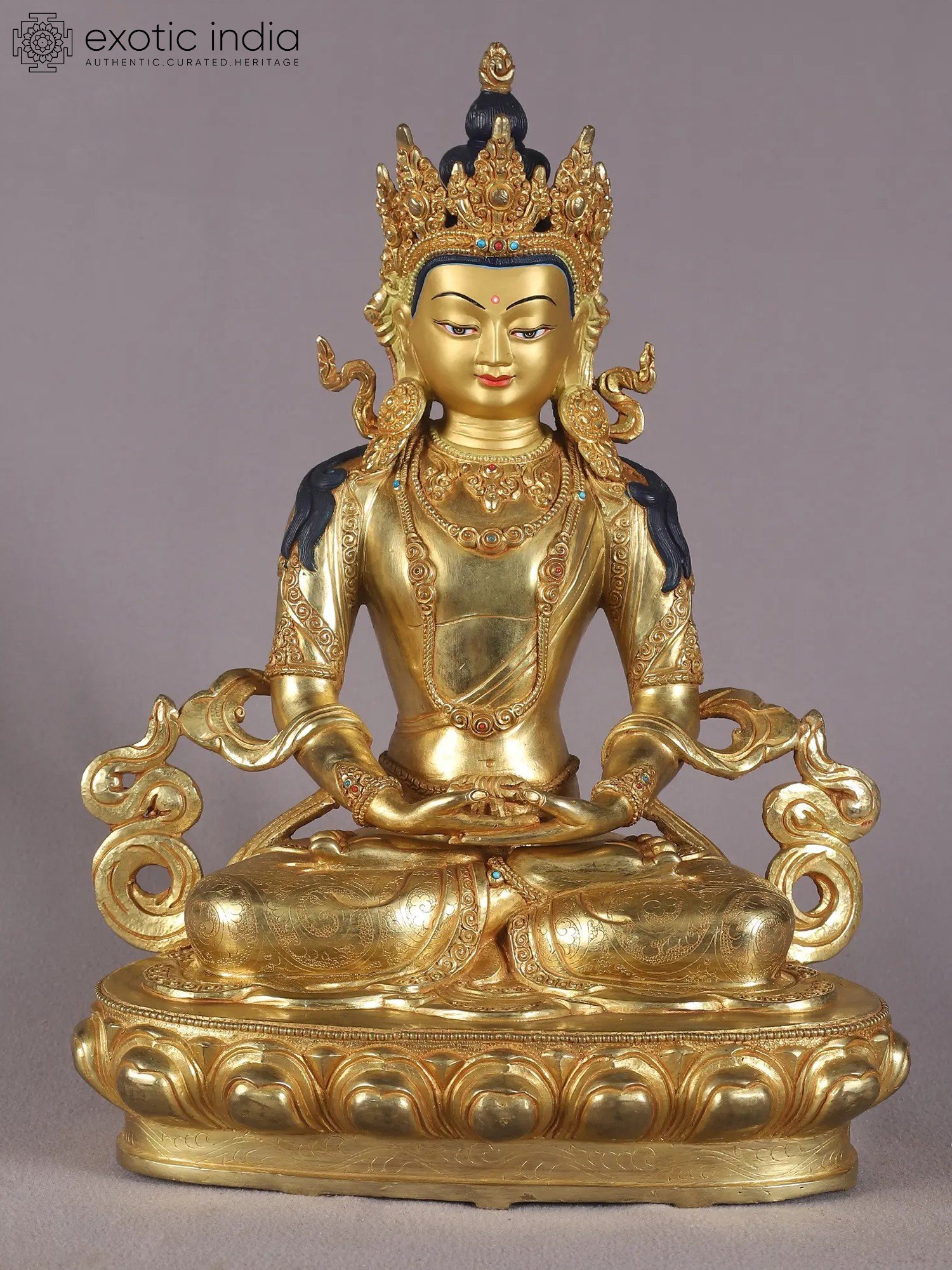
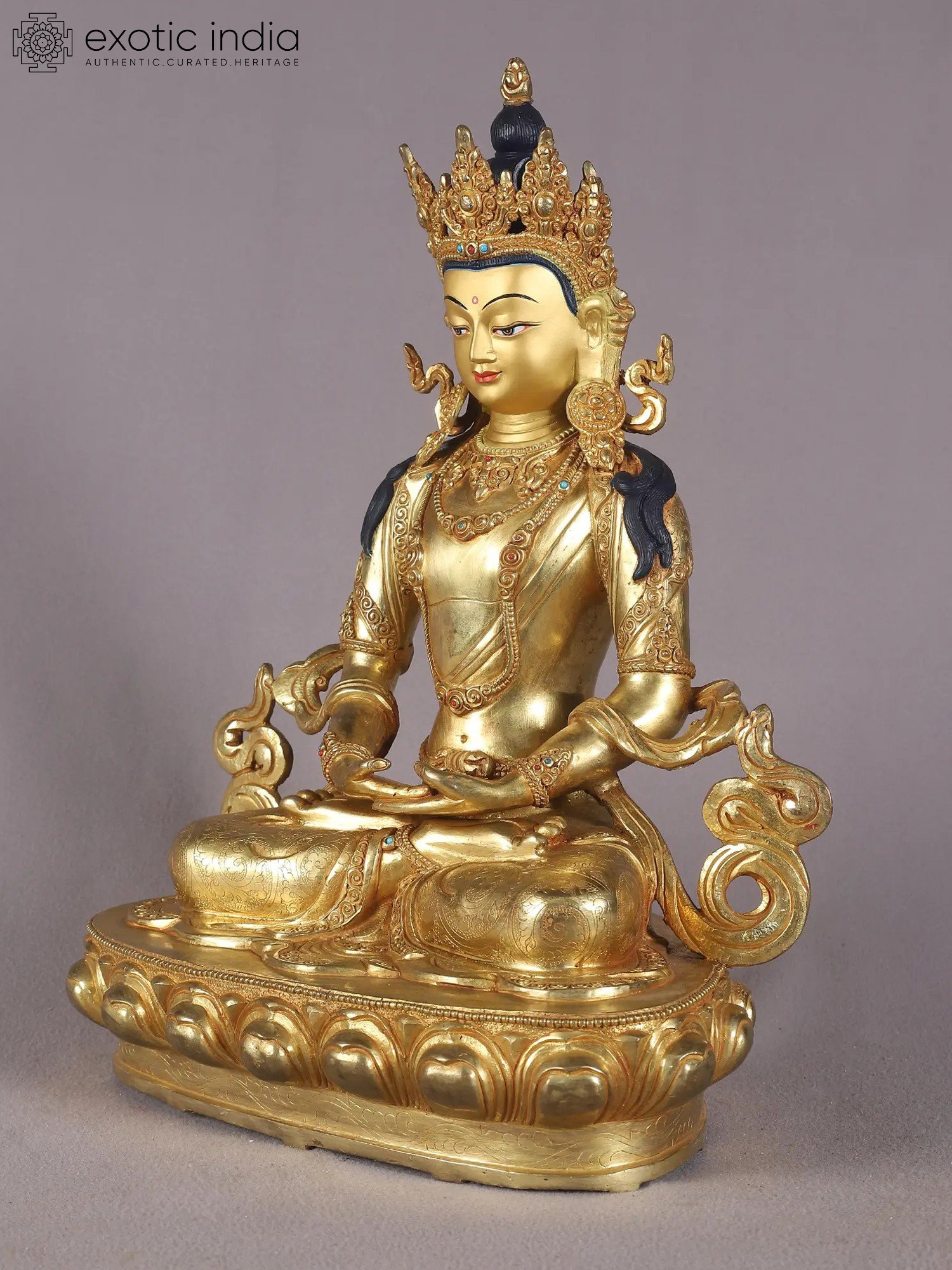
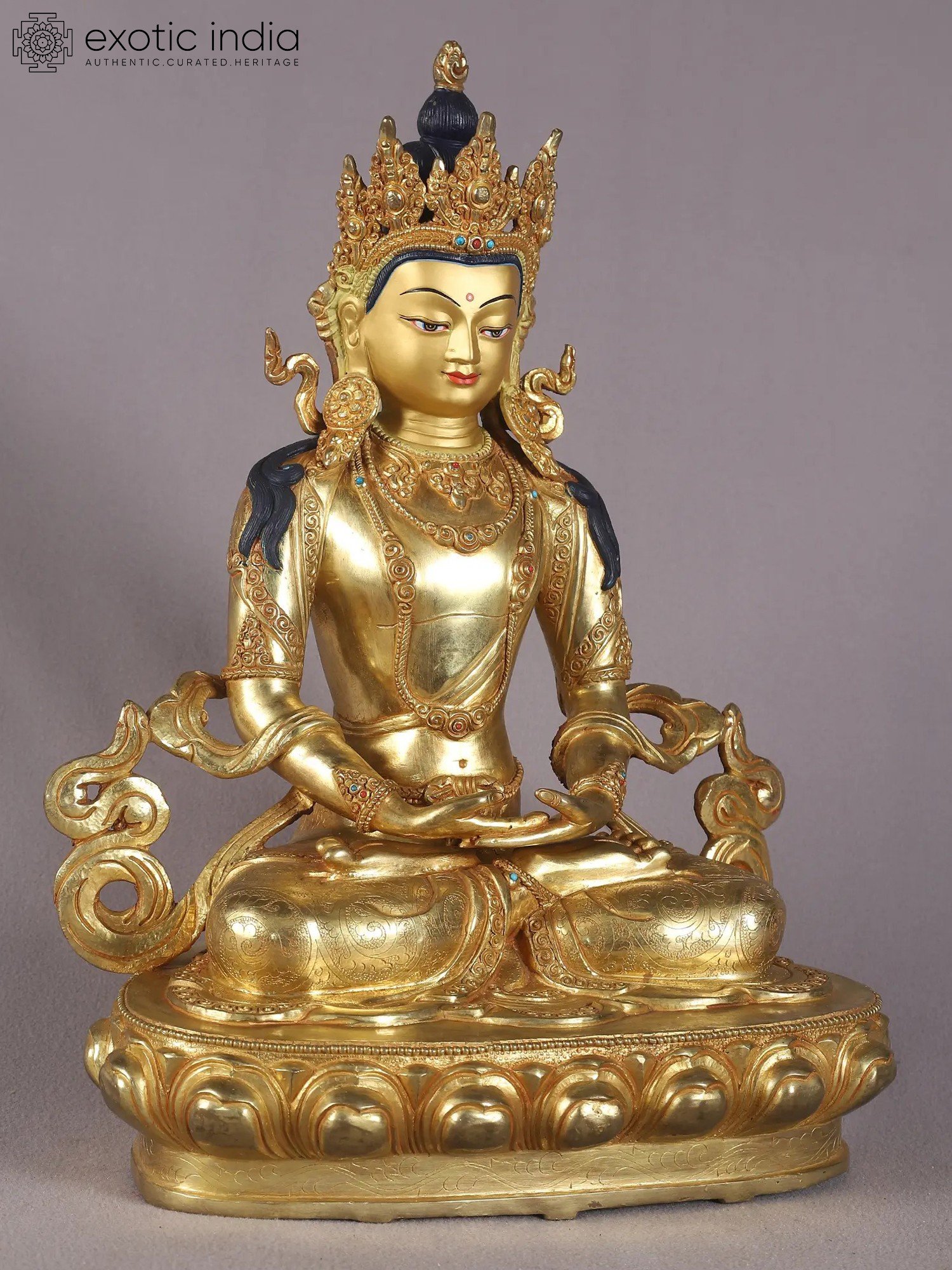
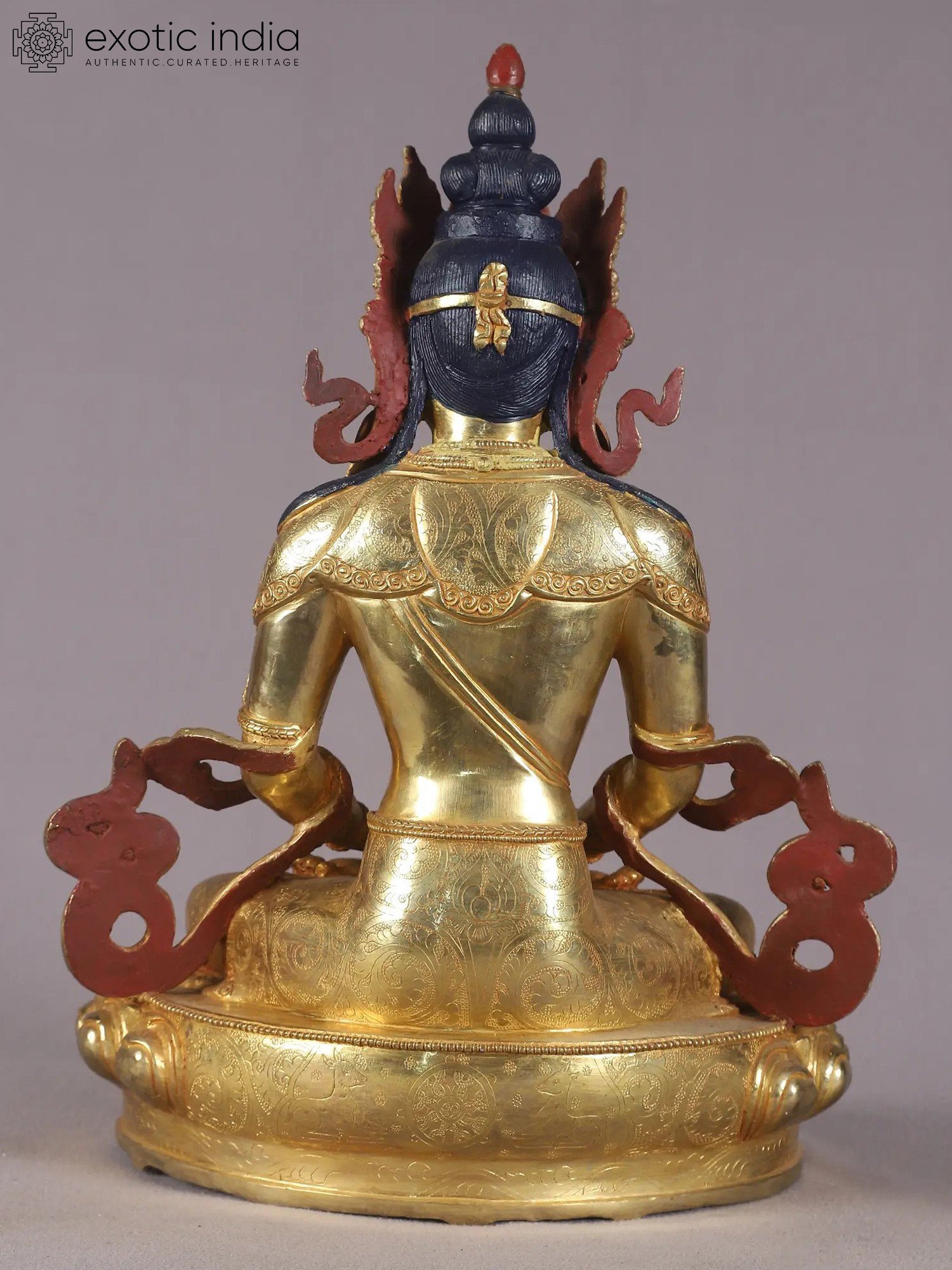
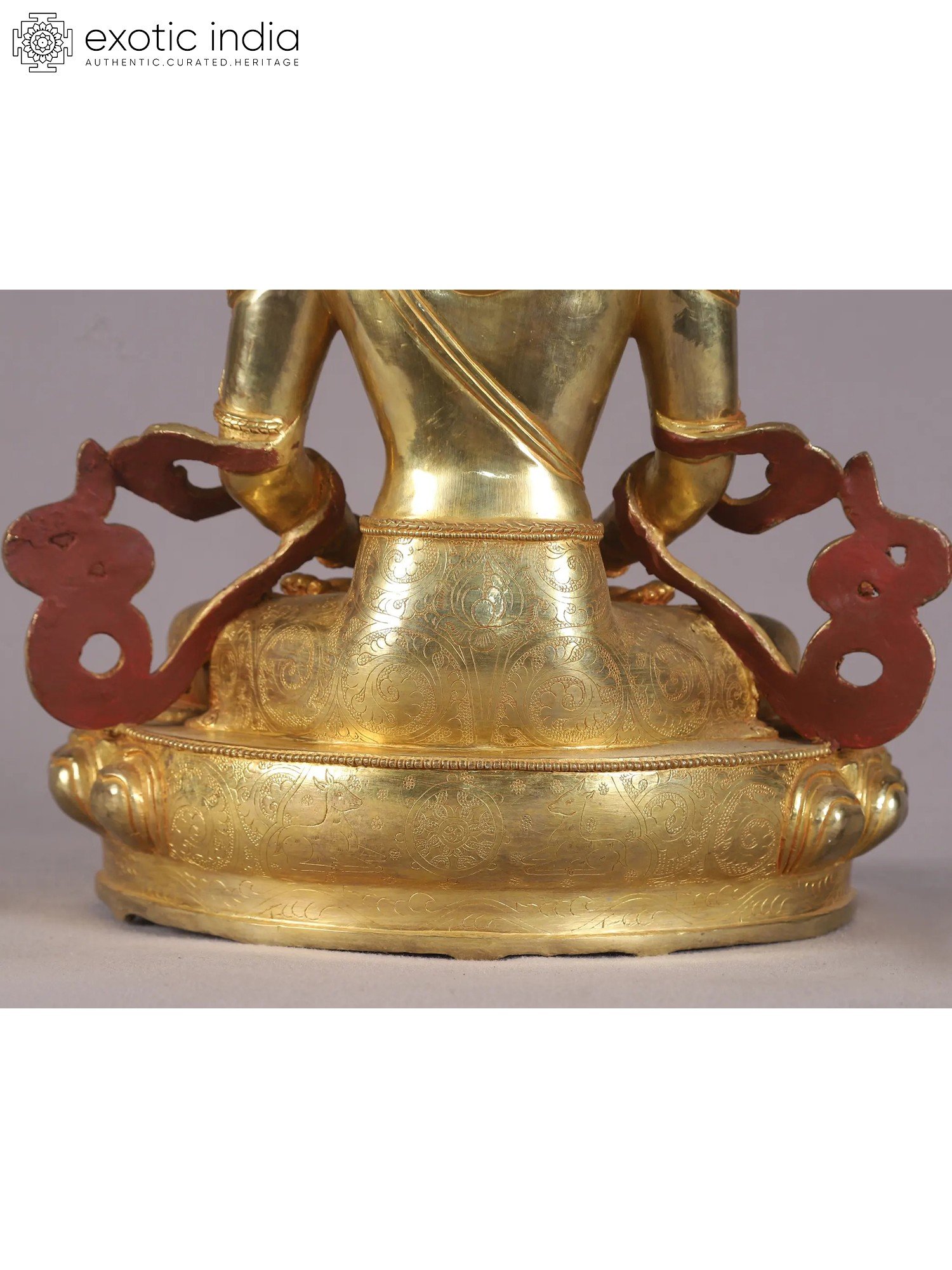
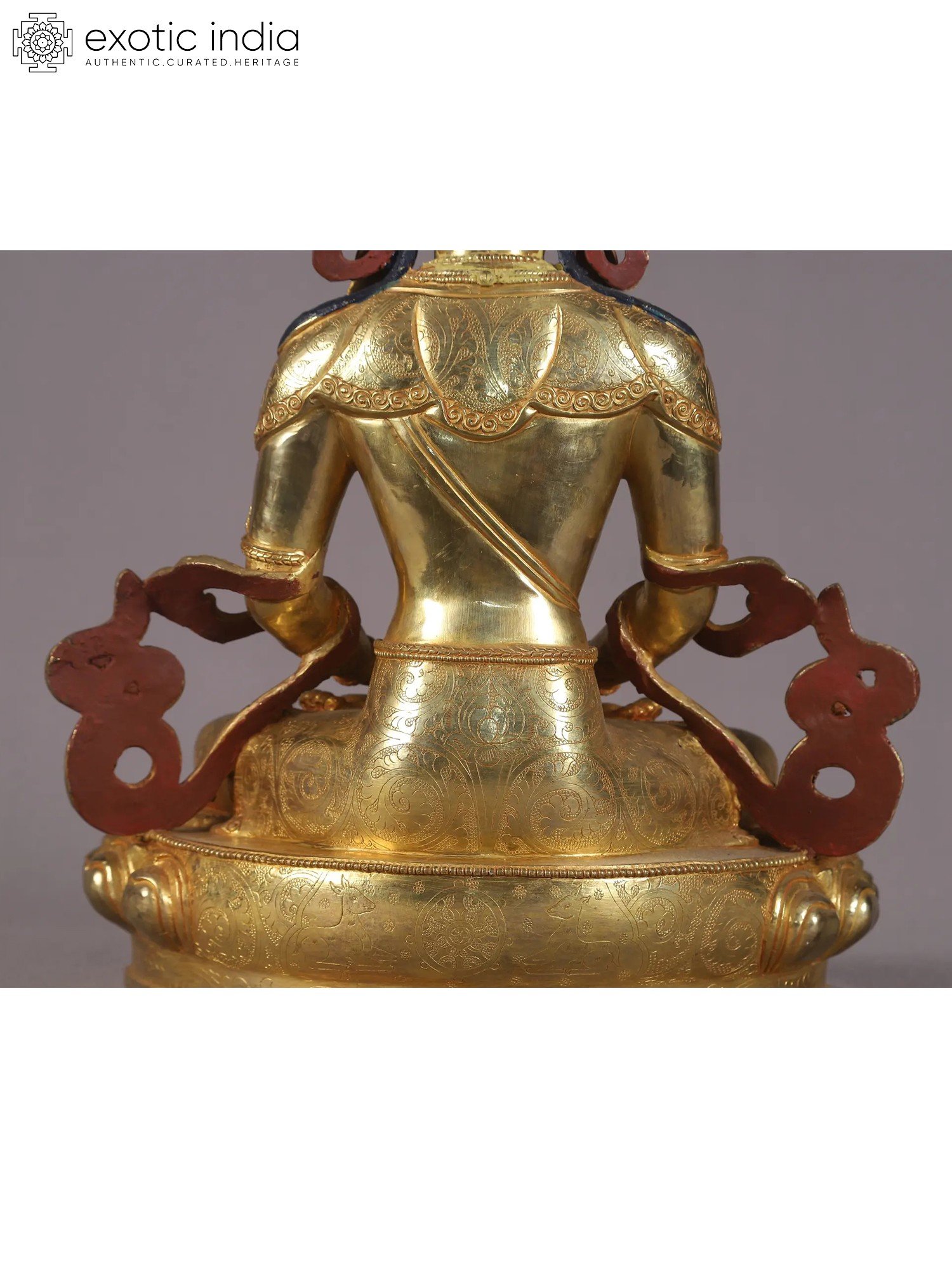
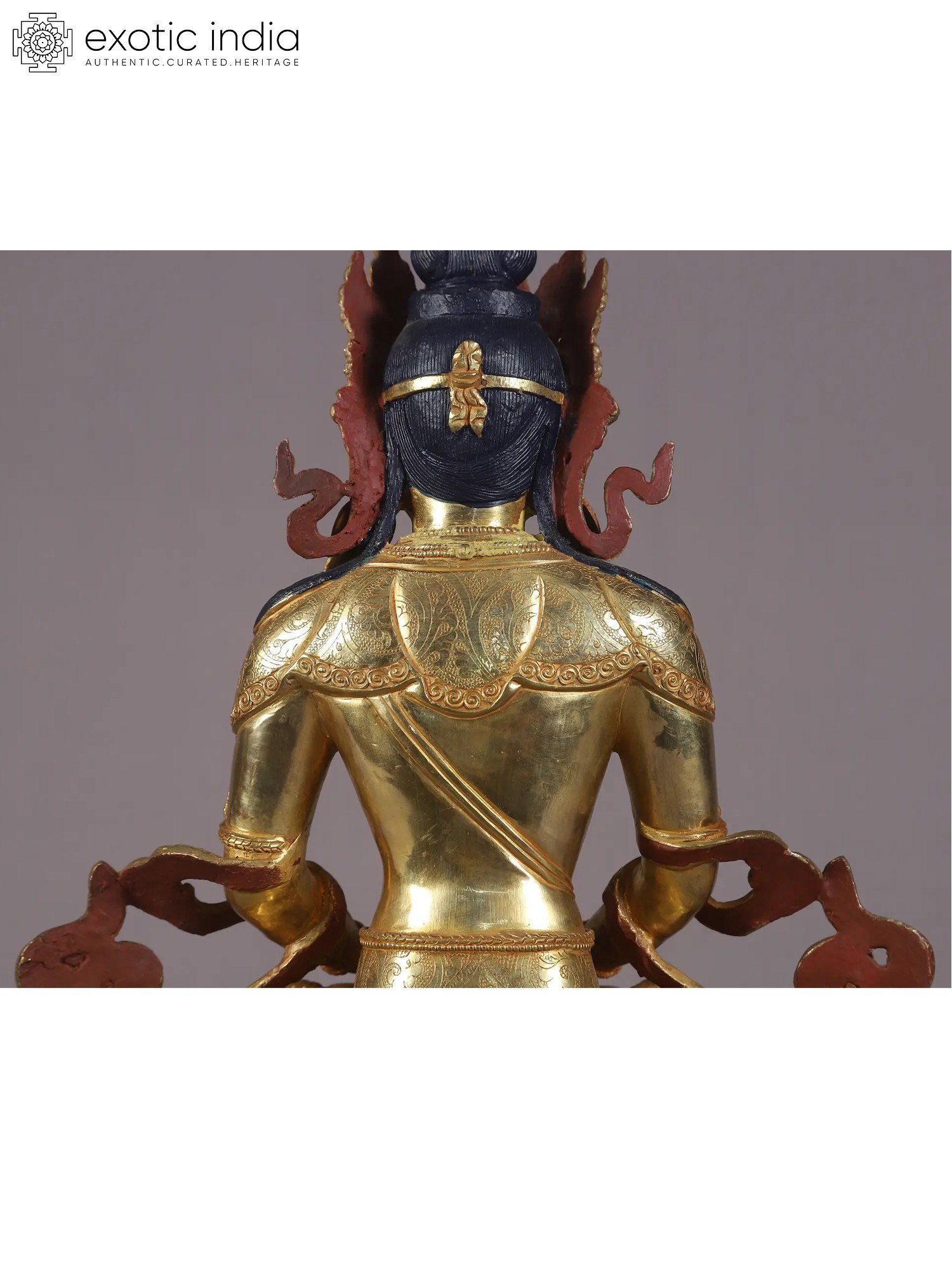
Golden Brass Amitayus Statue | Buddha of Infinite Life

| Specifications |
 |
CAA099 |
 |
Copper With Gold |
 |
Height: 15.5 inch |
| Width: 12 inch | |
| Depth: 7 inch | |
 |
Weight 6.10 kg |
| About the Item |
|
| Delivery and Return Policies |
 |
Usually ships in 6 days |
 |
Returns and Exchanges accepted within 7 days |
 |
Free Delivery |


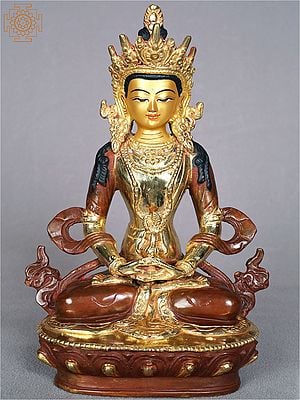
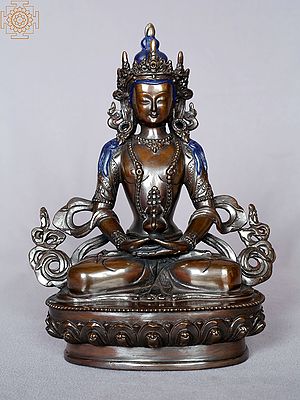
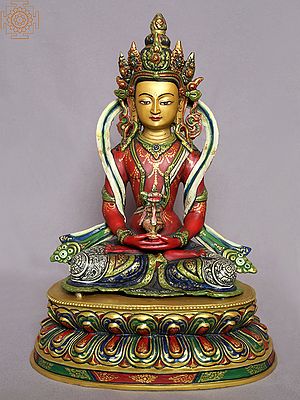
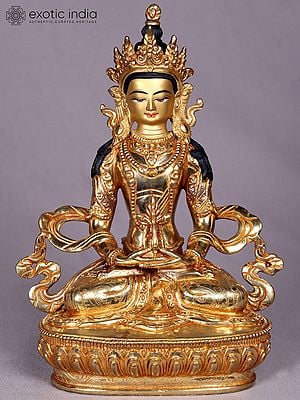
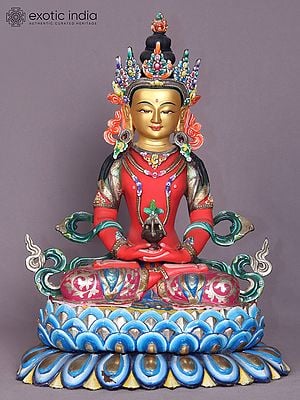
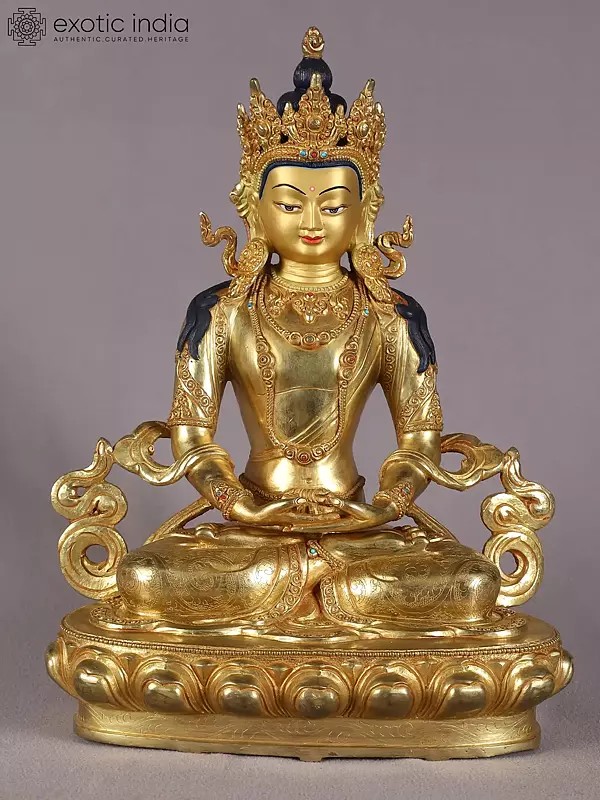
Lord Aparmita is revered as the
Buddha of Infinite Light and Infinite Life, and he personifies kindness,
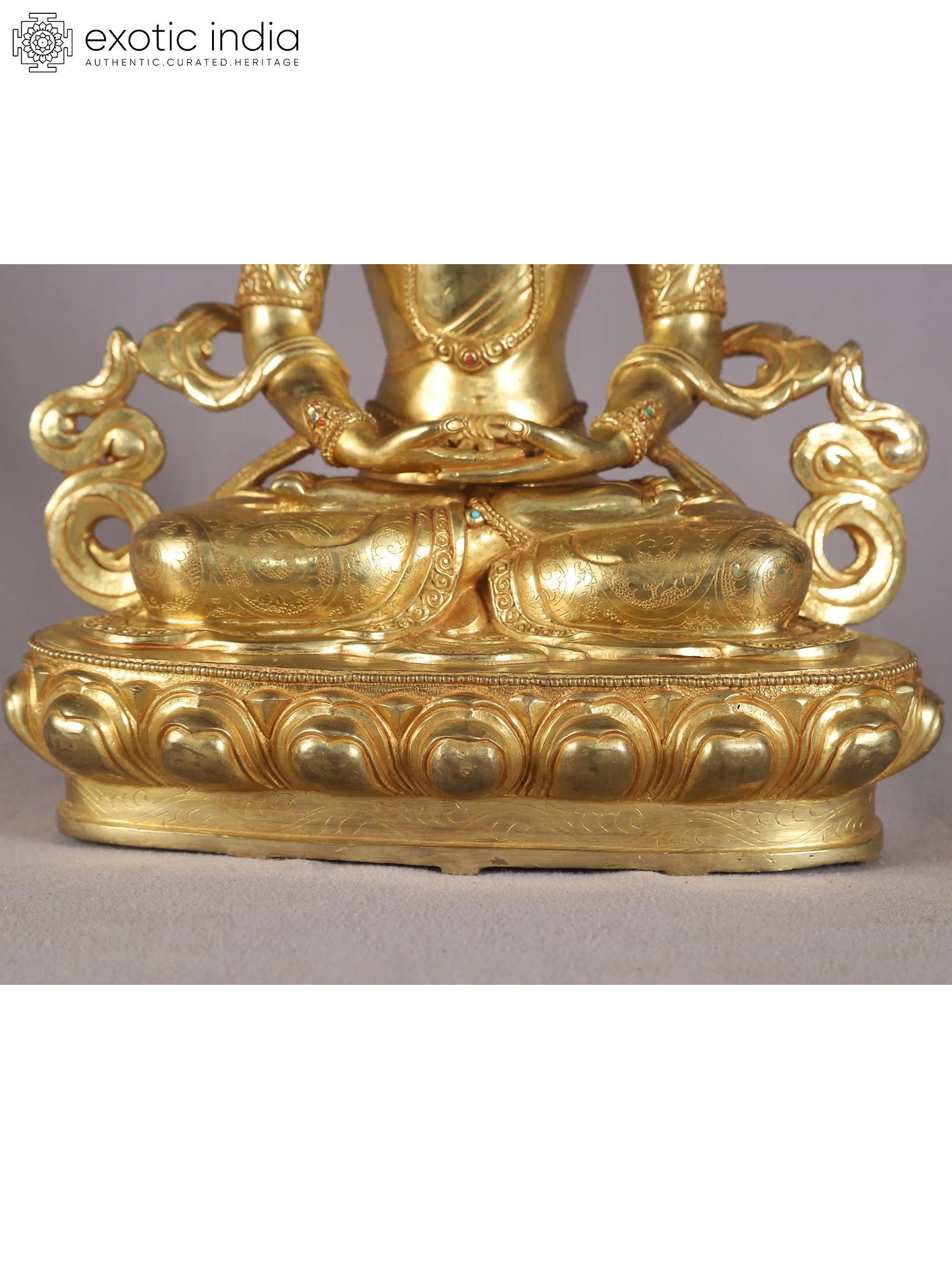
purification, and enlightenment. In this unique representation, Aparmita is
seated gracefully in the padmasana on a lotus pedestal with his right leg on
top of his left. His hands are resting on his lap in the dhyana
mudra (meditative gesture), symbolising the supremacy of the enlightened
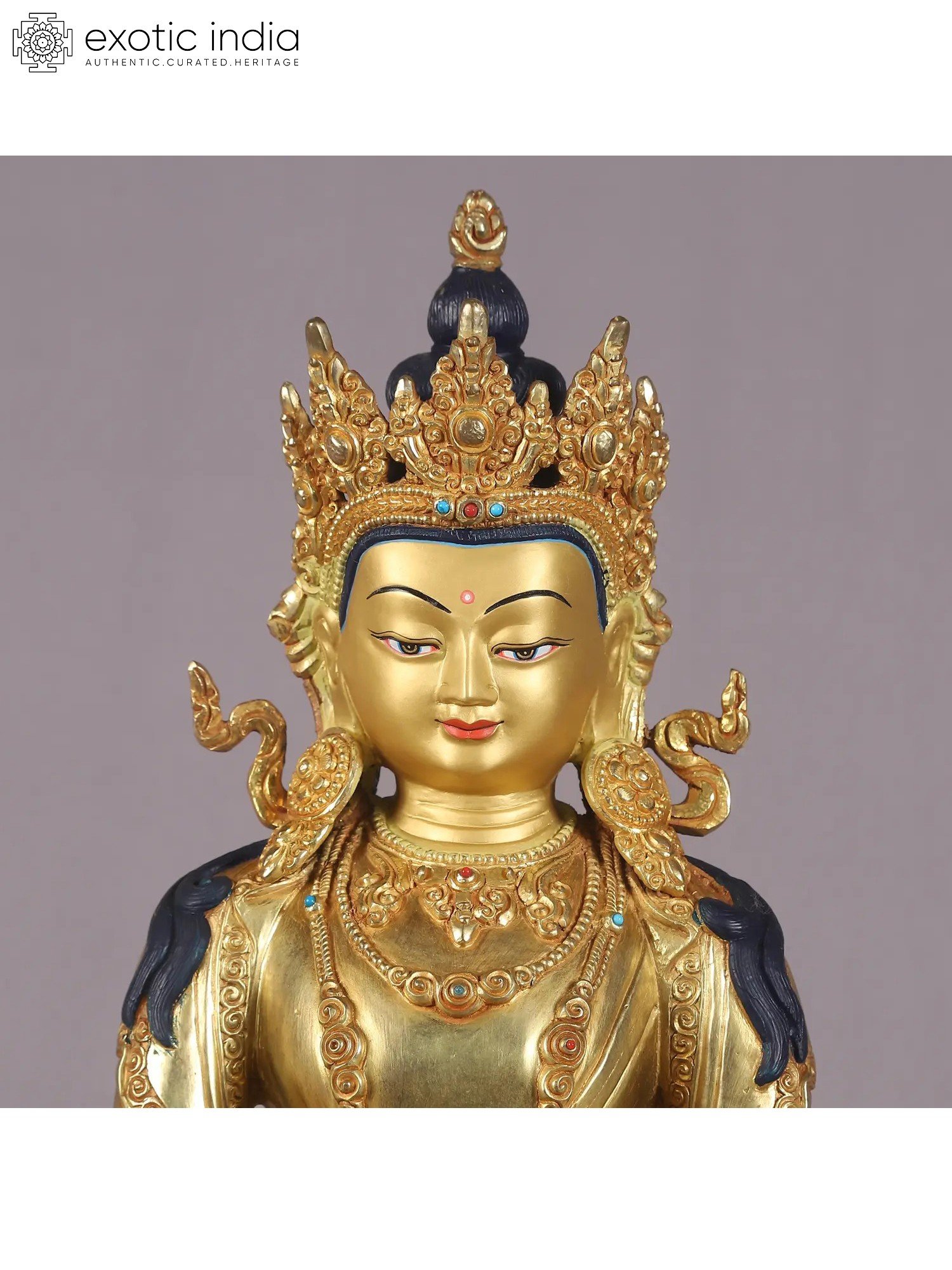
mind. Adorned in regal attire, he is dressed with heavy necklaces, anklets,
bracelets, earrings, and a five-pointed crown inlaid with precious and
semi-precious stones. Aparmita is referred to during rituals involving the
prolongation of life as the giver of longevity. It is said that by chanting the
sacred mantra of Buddha (“Om ami dewa hrih”) will shield you from obstacles and
dangers.
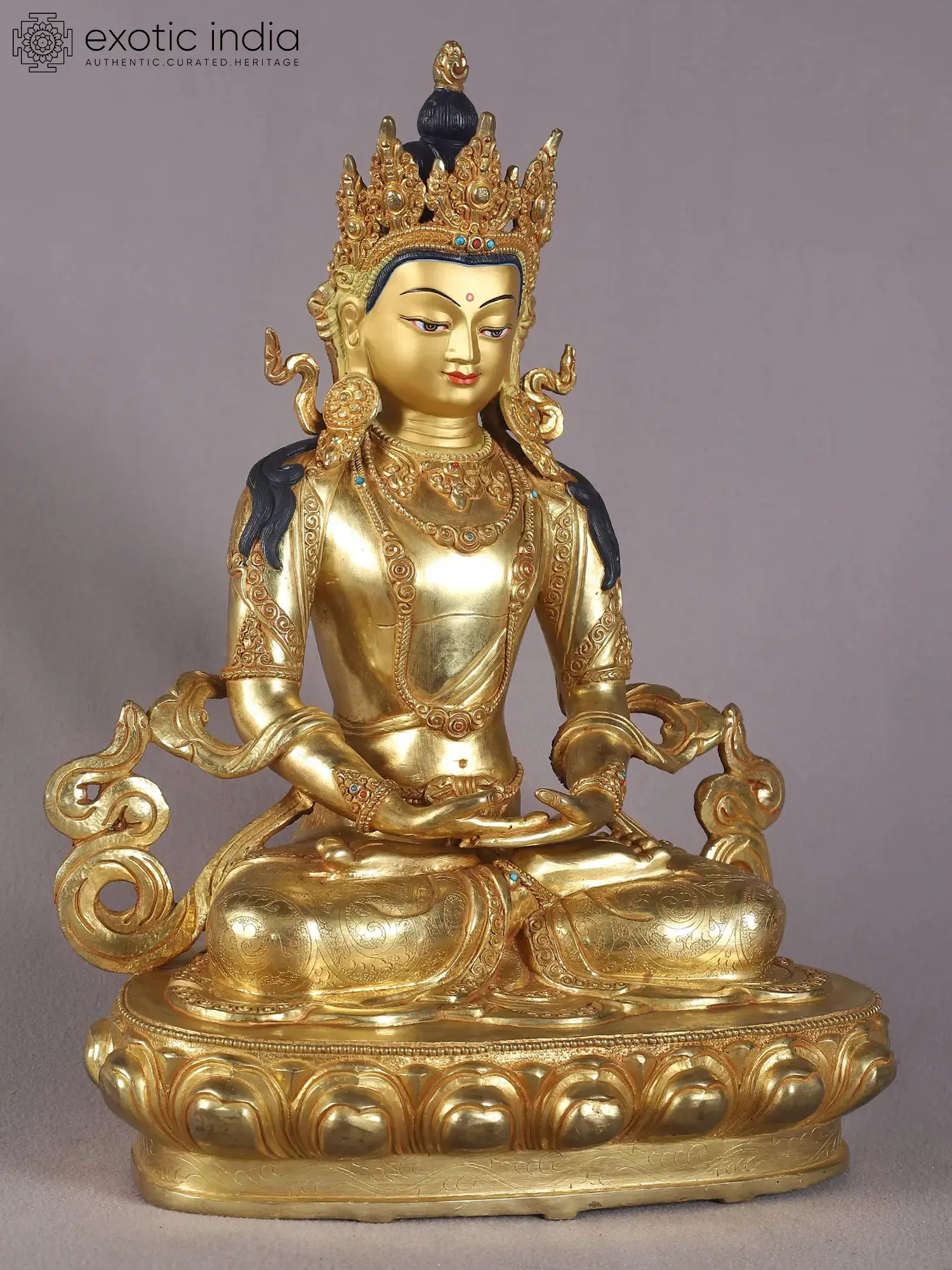
The Radiance of Boundless Life: Amitayus in Golden Splendor
This magnificent statue, crafted from lustrous copper and adorned with exquisite gold, embodies the divine presence of Amitayus, the Buddha of Infinite Life. Hailing from Nepal, a land steeped in Buddhist tradition and artistic mastery, this piece is more than just an idol; it is a conduit to profound spiritual contemplation and a symbol of eternal well-being. The artist's skilled hands have brought forth a vision of serene power, capturing the very essence of compassion and longevity that Amitayus represents. The posture of the deity is one of deep meditation and equipoise. Seated upon a multi-tiered lotus base, a symbol of purity and spiritual awakening, Amitayus displays the *dharmachakra mudra* in his hands, the gesture of turning the wheel of dharma. This signifies his role in teaching the path to liberation and enlightenment. His countenance is one of gentle wisdom, with downcast eyes that convey profound understanding and a serene smile that offers solace to all who behold him. The intricate details of his regalia, including a majestic crown and elaborate necklaces and armlets, speak to his enlightened status and the opulence of the Pure Land he presides over. ––––––––––––––––––A Testament to Timeless Wisdom
Amitayus is a central figure in Mahayana Buddhism, particularly revered for his association with longevity, merit, and the achievement of enlightenment. In Buddhist cosmology, he presides over the Western Pure Land, Sukhavati, a realm of ultimate bliss and freedom from suffering. Legends tell of Amitayus’s vow to save all sentient beings from the cycle of rebirth and to grant them a long and healthy life. Devotion to Amitayus is believed to purify negative karma, bestow good fortune, and ultimately lead to rebirth in his Pure Land. This statue serves as a tangible representation of these profound spiritual aspirations, inviting practitioners to connect with his boundless blessings. The striking combination of copper and gold is not merely aesthetic; it holds significant symbolic meaning. Copper, known for its durability and conductivity, represents the material world and the physical form, while the layer of gold symbolizes the divine, the illuminated mind, and the radiant nature of Buddhahood. Together, they create a powerful synthesis of the mundane and the sacred, a reminder that enlightenment can be attained within the realm of earthly existence. The meticulous craftsmanship, evident in every curve and embellishment, reflects the devotion and spiritual discipline of the artisans who created this masterpiece, making it a truly sacred object.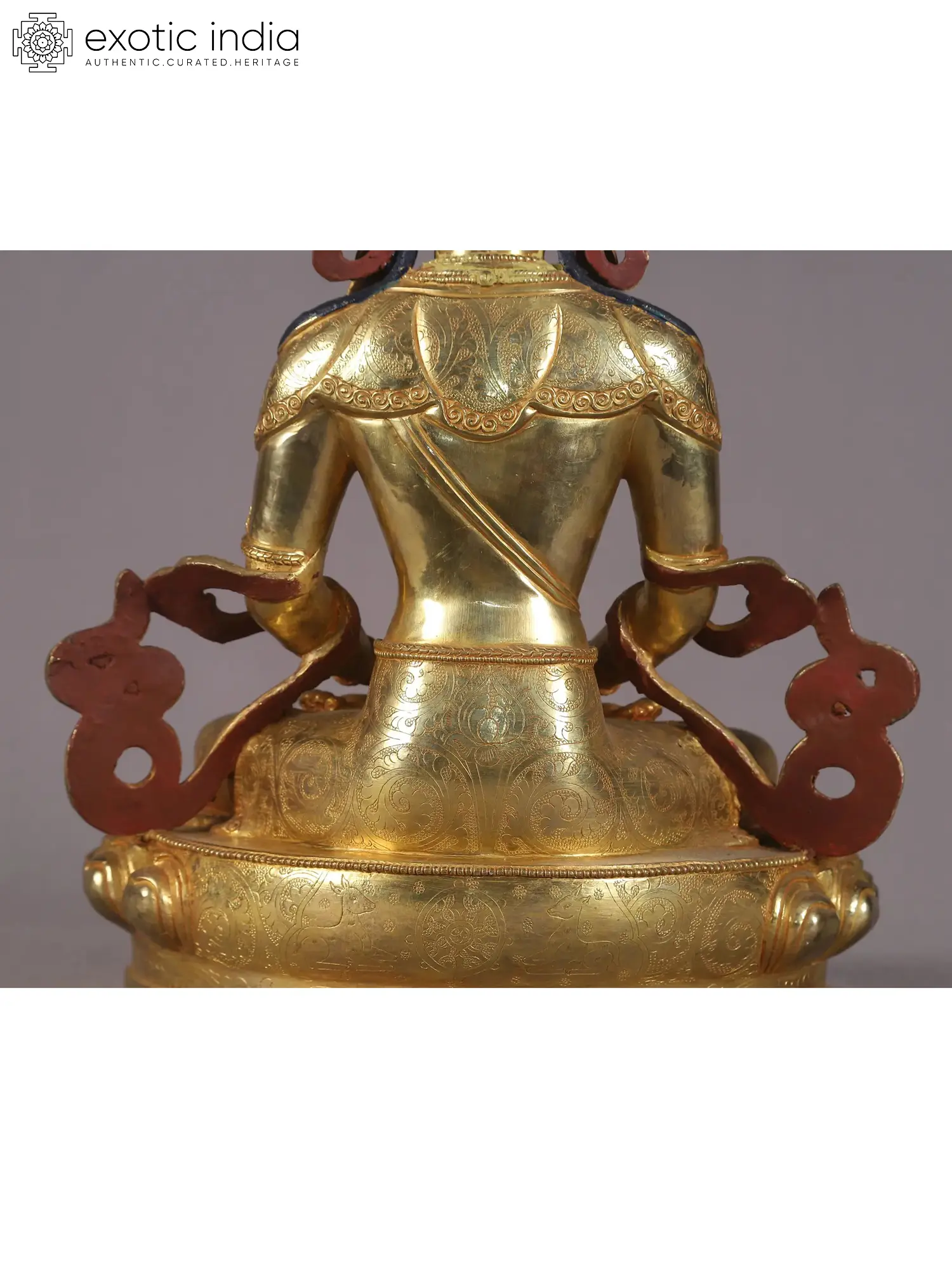
How are Nepalese copper statues made?
Nepalese statues and sculptures have a high copper content and therefore develop a slightly reddish patina on the surface as they age. However, the most unique feature of Nepalese copper statues is their decorative detailing. The pieces are heavily gilded and sometimes inlaid with semi-precious stones. This embellishment protects them from getting tarnished. The traditional lost-wax method for casting Nepalese copper statues remains the most practiced technique in Nepal for many centuries. This process involves many steps and requires skilled artists.
The first step in lost-wax sculpting is to make a wax replica of the desired Buddhist deity to be cast in copper. This replica is created by hand and therefore needs excellent artistic skills otherwise fine features will be lacking.
Once the wax replica is made, it is then coated with a special mixture of clay with a brush. This layer of clay is hardened when left to dry. A small hole is made on the base of the wax mould so that the wax flows away when it is heated.
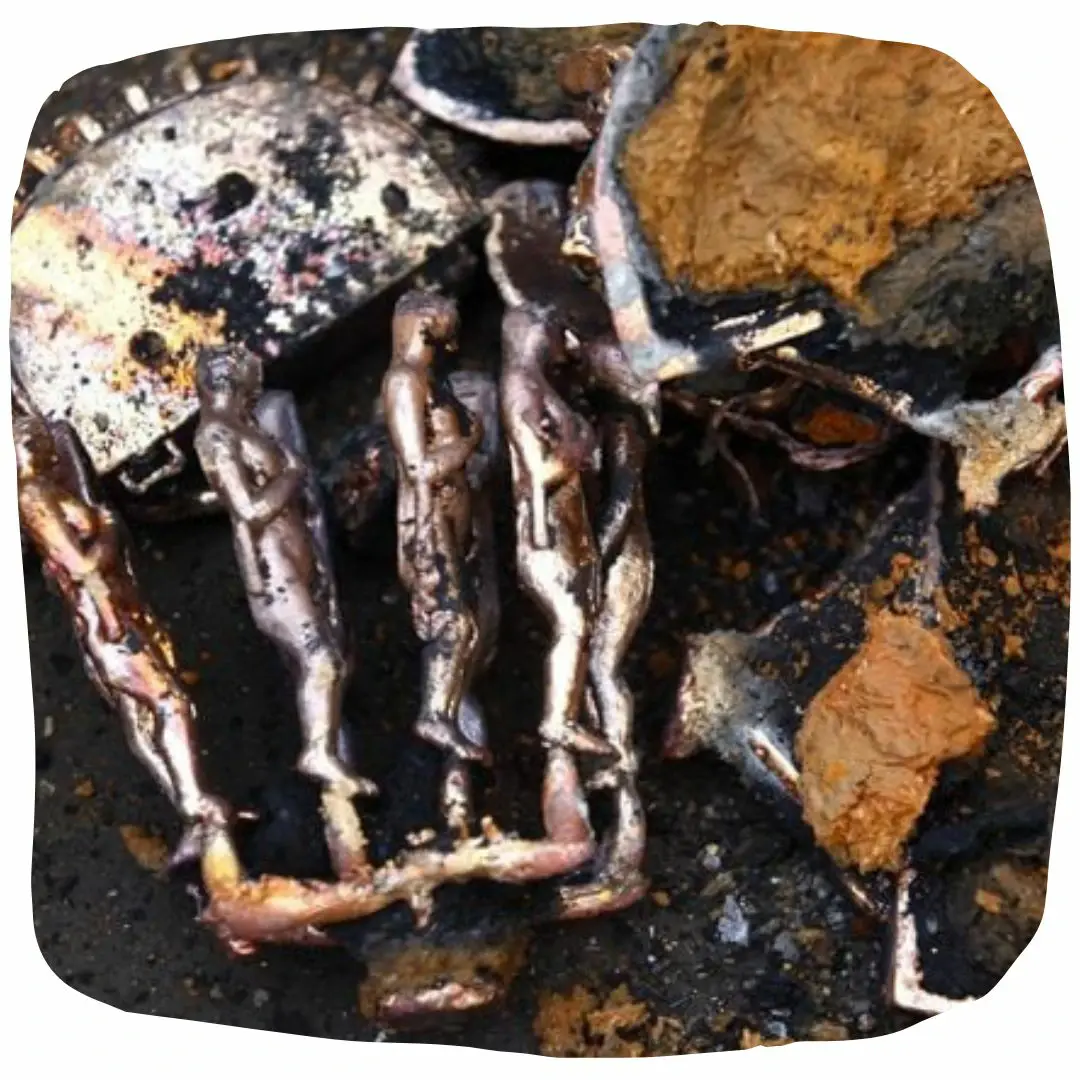
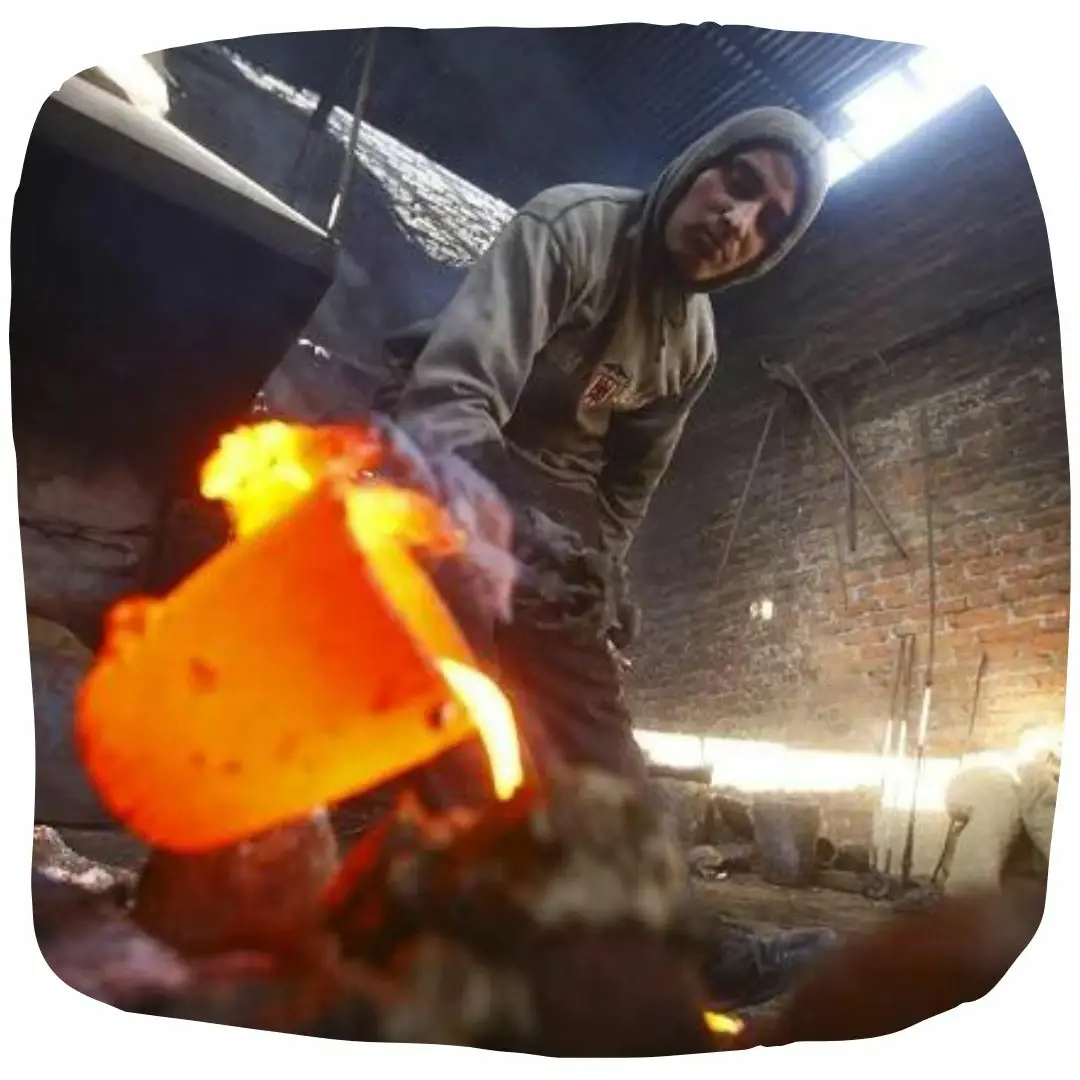
This is the time to pour liquid copper into the hollow mould which is then allowed to cool and harden inside a container of cold water. When the liquid metal has hardened, the mould is removed and the statue within is revealed.
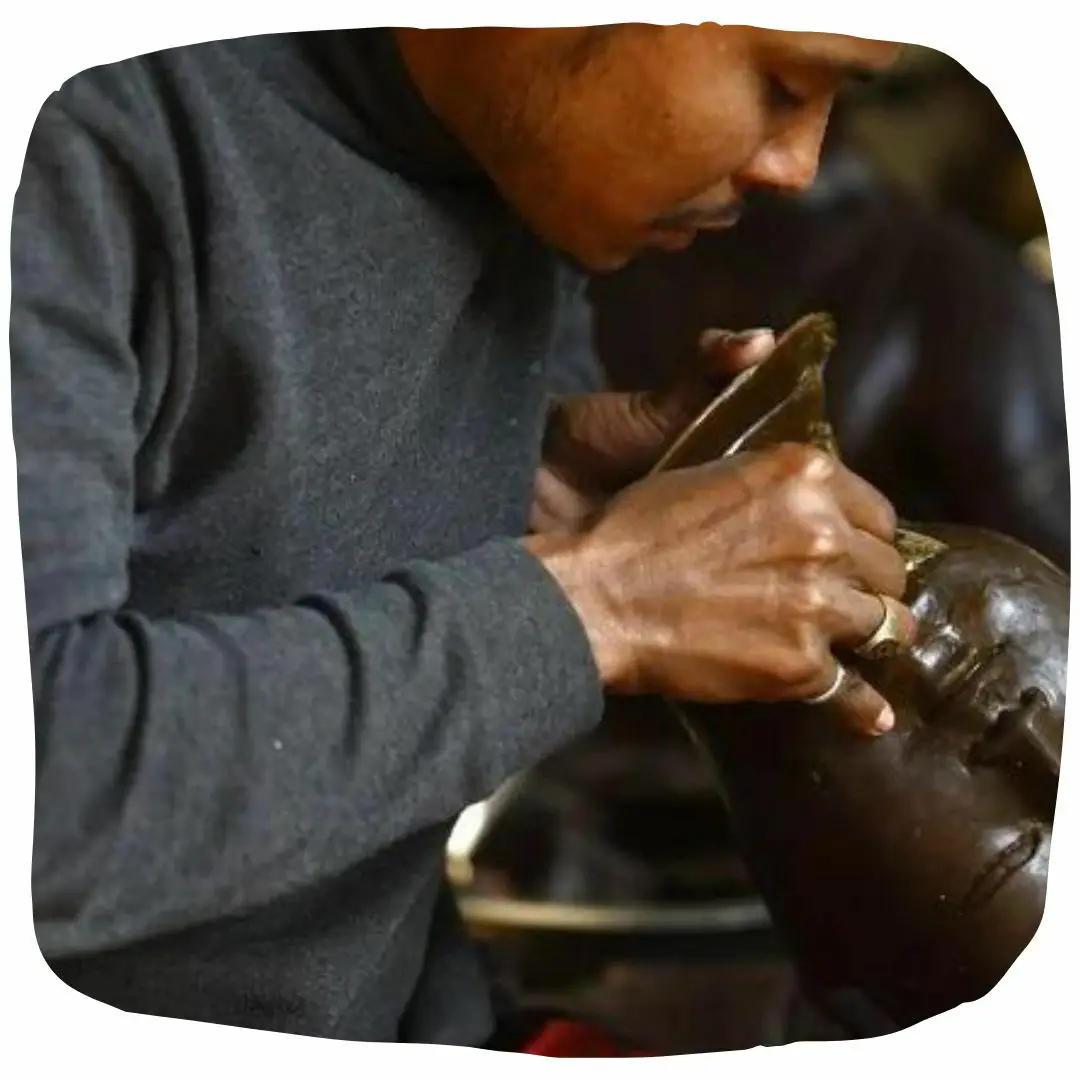
Now comes the most important part of Nepalese art which is gold gilding. This is done by the traditional fire gilding method. A mixture of mercury and 18K gold is applied on the surface of the statue and heat is applied using a flame torch. The result is that mercury evaporates along with impurities, leaving a pure 24K gold finish.
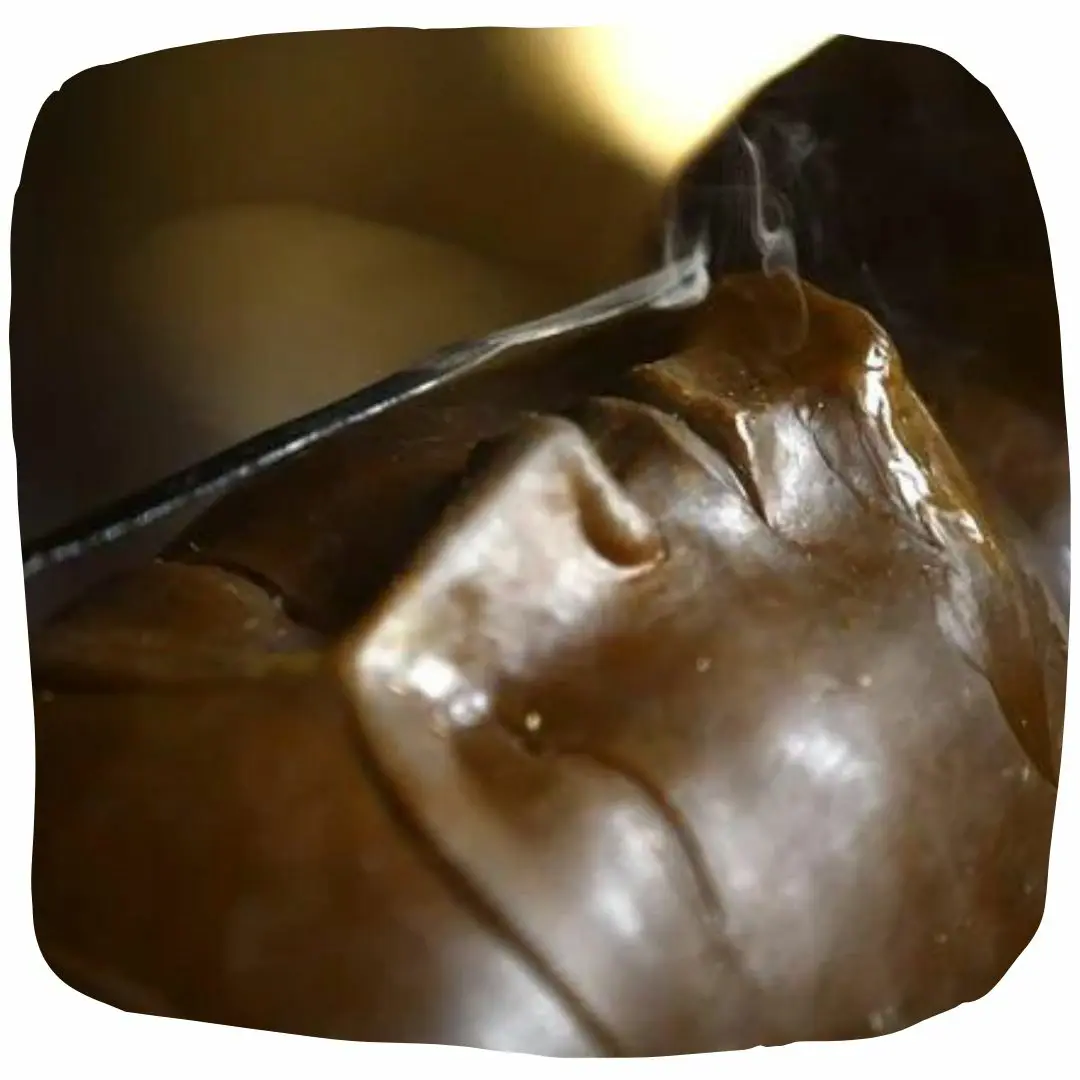
The lost-wax method of sculpting is the most preferred technique
for artists to cast a metallic statue having intricate details. Since Nepalese copper sculptures require extraneous effort for giving a majestic look by adding special embellishments, it takes several weeks to complete one masterpiece. A 24K gold gilded copper sculpture retains its brilliant luster for many years and appears as like before. Nepalese sculptures continue to remain one of the finest specimens of the art of the East that have a strong aesthetic appeal that other sculptures cannot match.