| Specifications |
 |
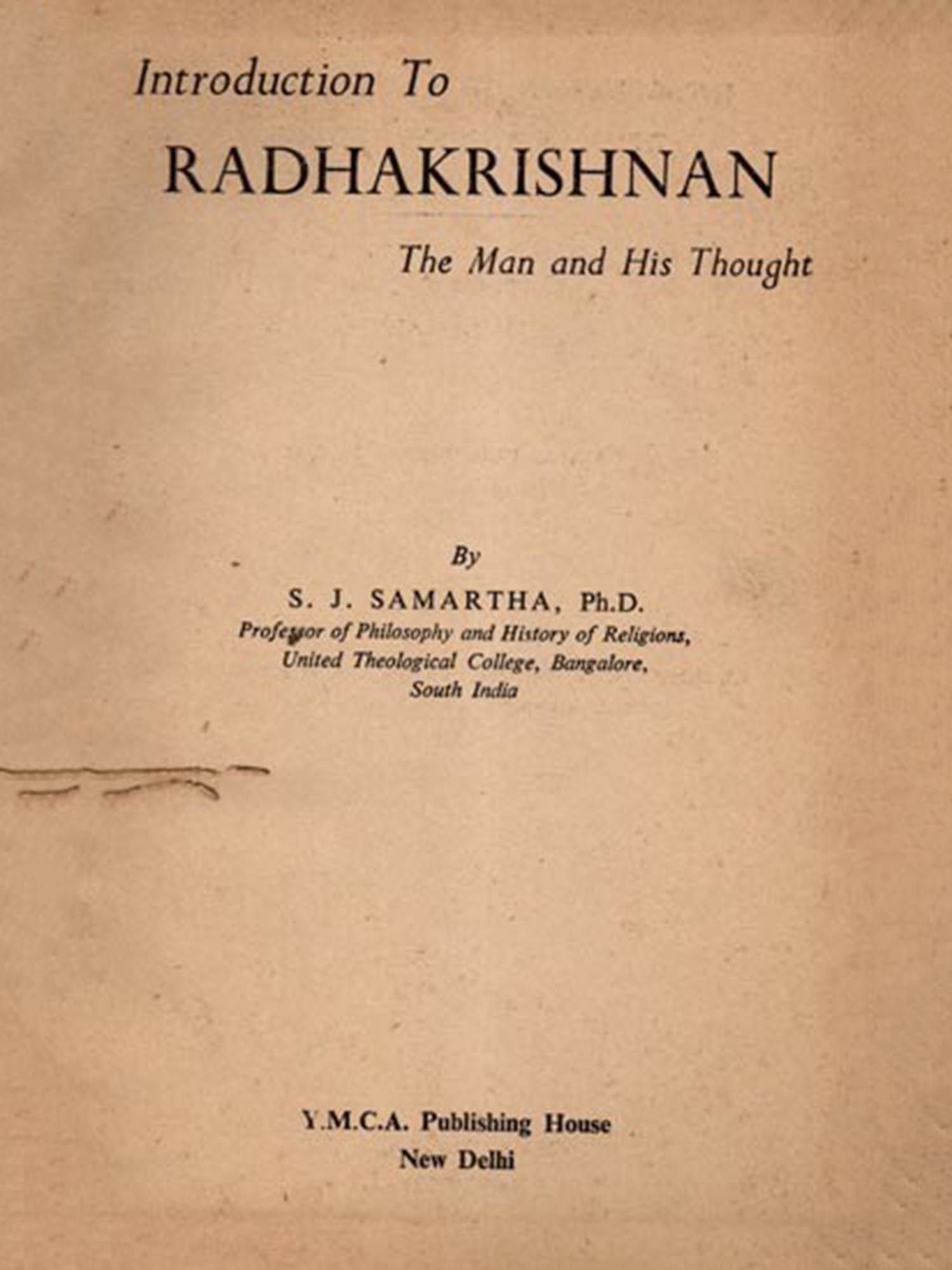
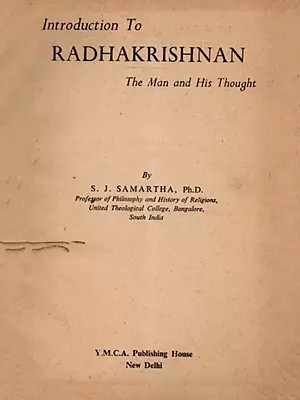
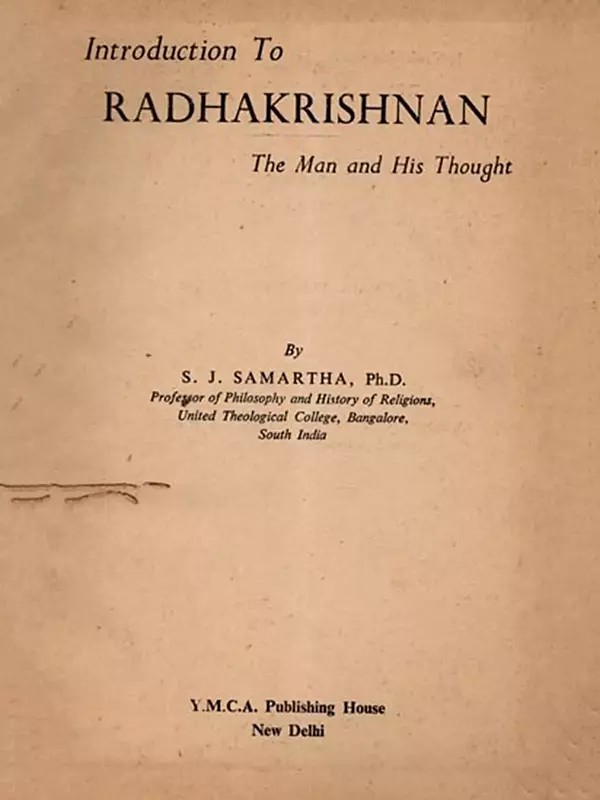
Publisher: Y. M. C. A. Publishing House, Delhi |
| Author Stanley Jedidiah Samartha | |
| Language: English | |
| Pages: 119 | |
| Cover: HARDCOVER | |
 |
7.5x5.00 inch |
 |
Weight 180 gm |
| Edition: 1964 | |
 |
HBT609 |
| Delivery and Return Policies |
 |
|
 |
Returns and Exchanges accepted within 7 days |
 |
Free Delivery |


F ROM Farquhar's days, the YMCA in India, through its Literature Department has attempted to present to succeeding generations of youth books on the rich heritage of India-its sculpture and painting, its literature and philosophy. In those days the highway of print was not so crowded as it is today, and our volumes were valued by students and teachers alike for their objectivity and scholarship. The subject of this book used to browse in our book shop at 5, Russell Street, Calcutta, and presumably is well-acquainted with our various publications.
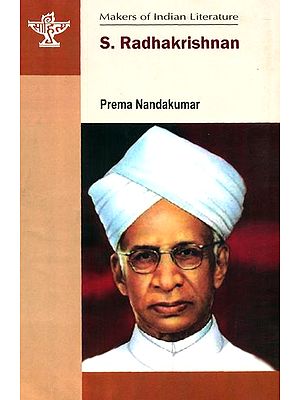
Although we still cling to our original purpose, time and circumstance have somewhat reduced our output in recent years. Therefore, publication of this book on Radhakrishnan is a great event for us and we hope for the reading public as well. Heavy tomes on Radhakrishnan are available but it is not easy to come by such a readable and intense treatise on our philosopher-statesman. I am sure many a student will be grateful to the author for this most welcome "introduction" to the thought of Radhakrishnan.
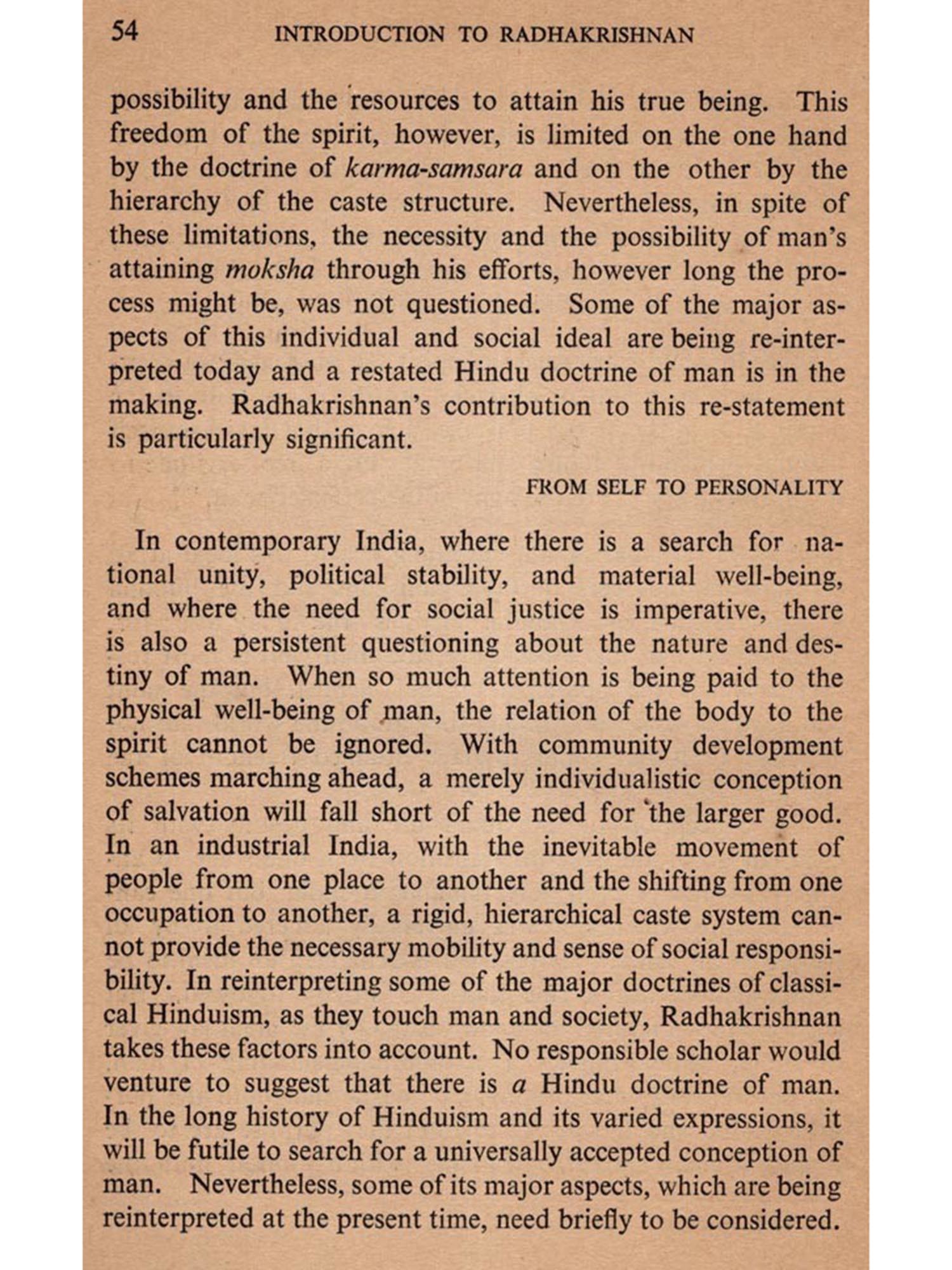
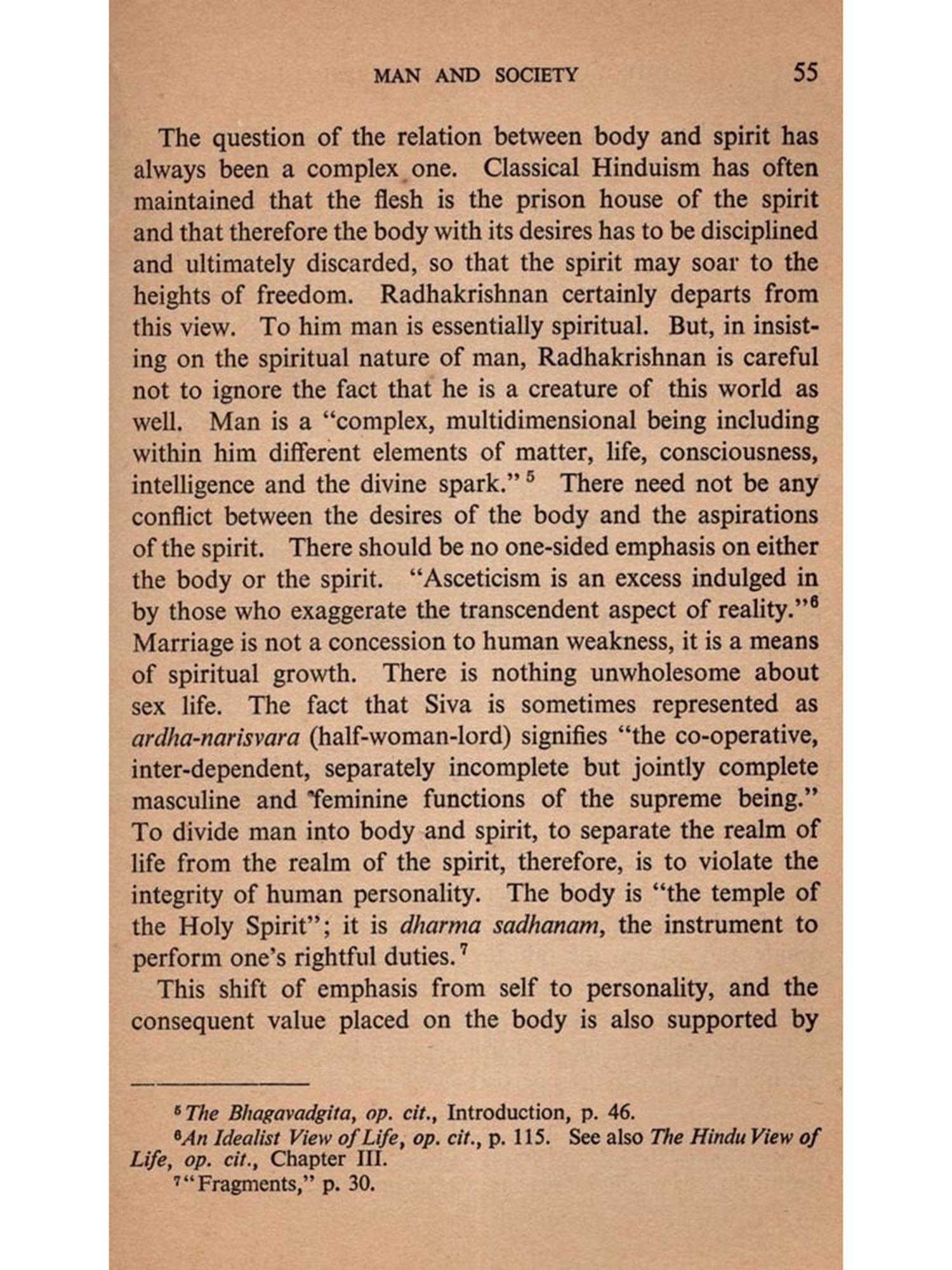
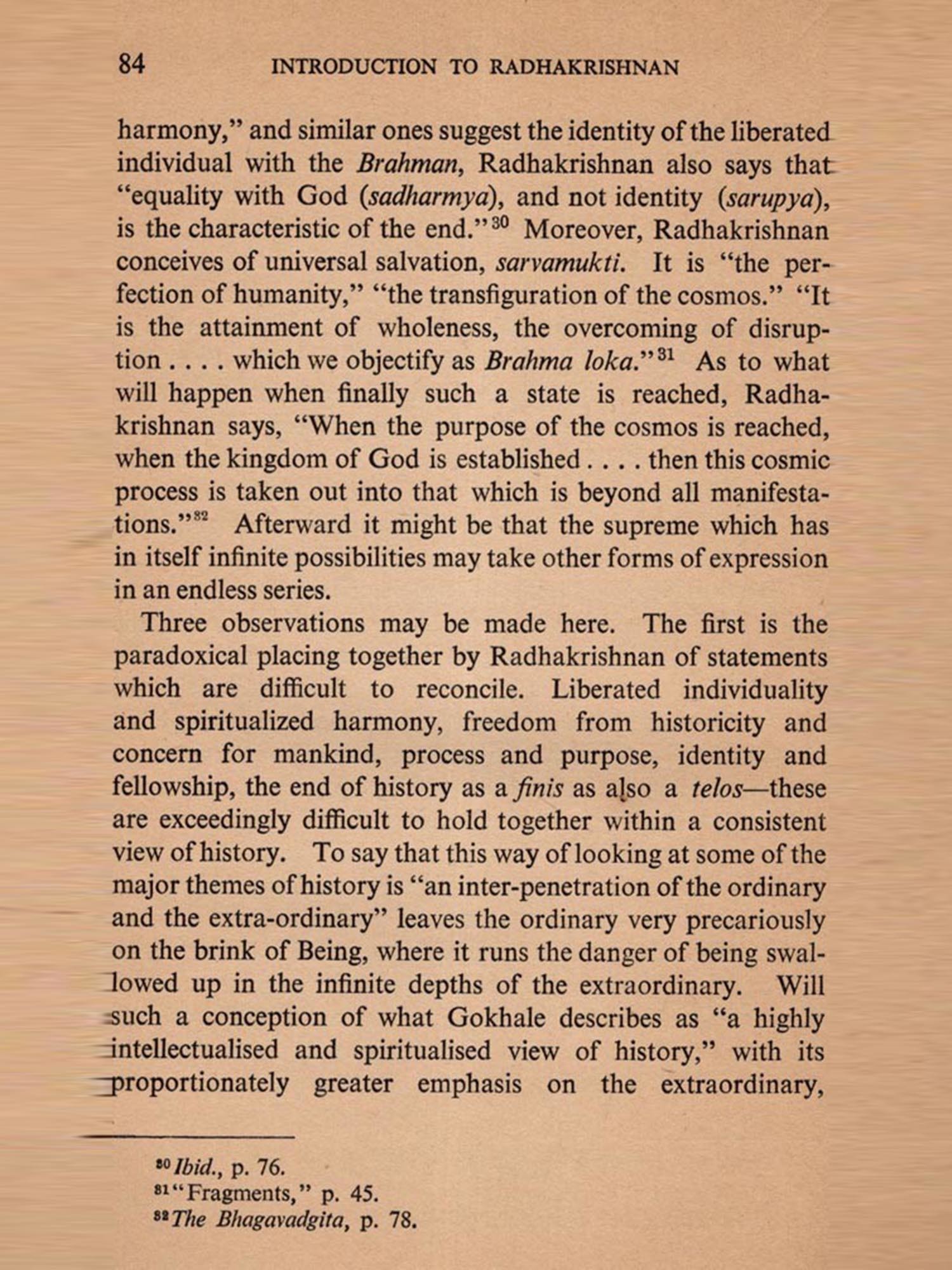
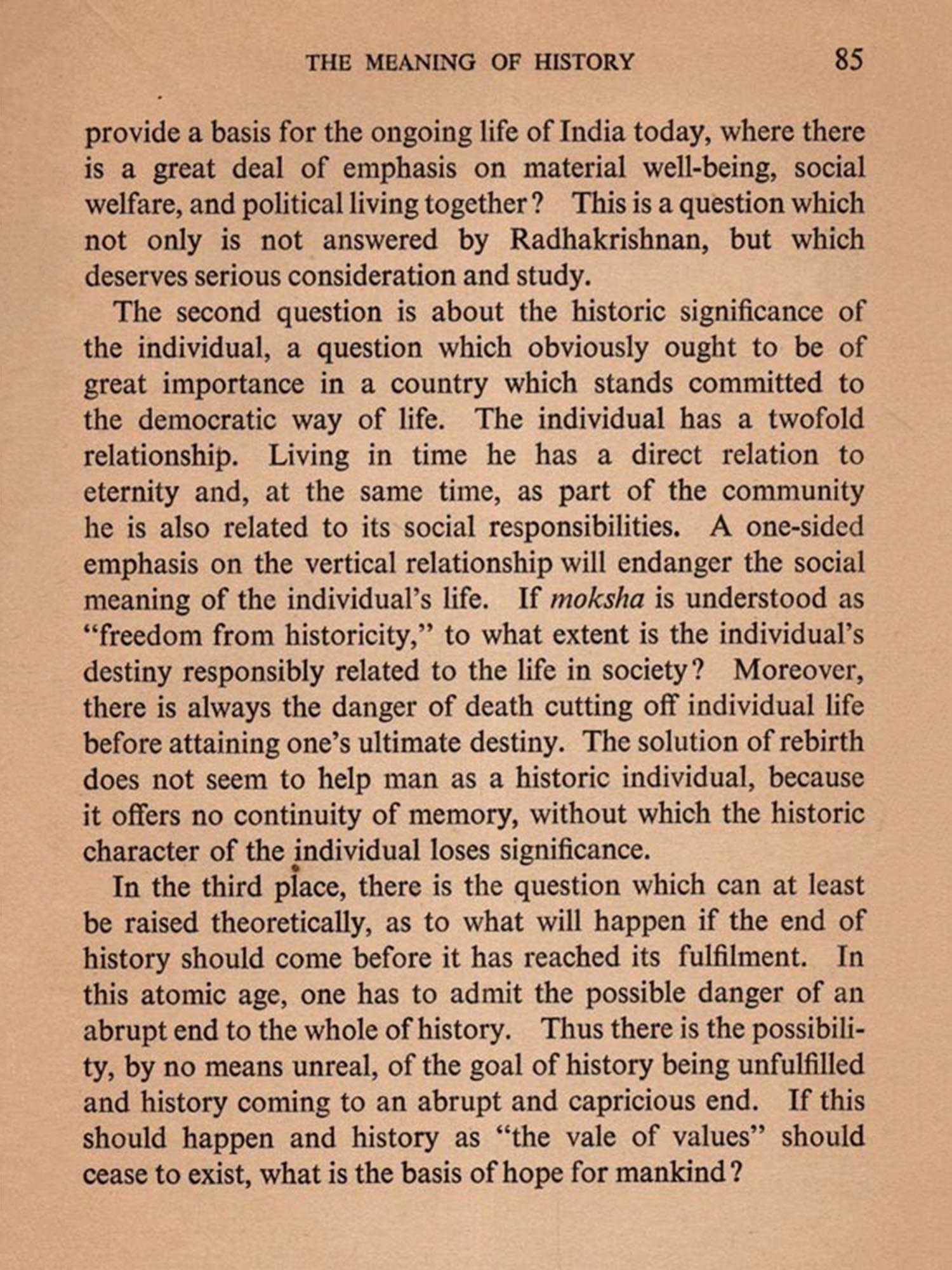
THIS book is an introduction to the essentials of Radha- krishnan's thought. Books written by Radhakrishnan are easily available, but the general reader or the student of philosophy will hardly find a single book which, within a brief compass, gives a survey of the fundamentals of Radha-krishnan's thought. This book aims to meet this need. While its major concern is with an exposition of Radhakrishnan's teachings, its purpose is not merely expository, for critical interpretation also forms a necessary part of this work. In the present dialogue between the East and the West at all cultural levels and in the encounter between world faiths today, it is necessary to have both a fair exposition and a responsible appraisal of differing points of view. Without this, mere friendliness will not lead to deeper understanding.
The importance of Radhakrishnan both as a representative of the renaissance of modern India and as one of the interpreters of its religio of interpretation and practical application. Radhakrishnan's significance, in this context, lies in the fact that he is not mere-ly a philosopher, but also a responsible statesman actively participating in the life of the country. As President of the Republic of India, he brings to this exalted office wide scholar-ship, deep thought, mature experience, broad vision and a profound concern for the life of the nation in the world of today. While being rooted in the national heritage of the country, he seeks to go beyond its narrow confines leading to the larger horizons of international understanding. In a considerable measure therefore, to understand Radha-krishnan's thought is to understand the new outlook that is slowly shaping.itself in India and elsewhere.
My indebtedness to friends and colleagues whose interest, encouragement and advice have helped me in the preparation of this book cannot be adequately expressed. The substance of these chapters has been given several times in the form of lectures at the United Theological College, Bangalore, to students from India and abroad. The questions and observations of my students and the responsible comments of my colleagues have always been most stimulating. The late Dr. P. D. Devanandan, formerly Director of the Christian Institute for the Study of Religion and Society, Bangalore, and Mr. M. M. Thomas, its present Director; my colleagues Dr. R. V. Spivey, Dr. K. Baago and Dr. M. H. Harrison; also Dr. V. C. Samuel and Dr. E. L. Wenger of Serampore College, Serampore; and Mr. D. K. Sebastian of Bishop Cotton Boys' School, Bangalore, have gone through the manuscript of this book wholly or in part and have made many suggestions for improvement. Professor M. Yamunacharya, formerly of the University of Mysore and Prof. C. T. K. Chari, Chairman of the Department of Philosophy. Madras Christian College, have kindly read the manuscript and have made philosophic foundations cannot be over estimated. It is true that in the complex cultural life of our country today other trends are also discernible which seek to reinterpret the old foundations to meet modern de-mands. Between militant Hinduism on the one hand, and aggressive secularism on the other, there are many shades of thought and action.







Send as free online greeting card



Visual Search
 Upload an Image