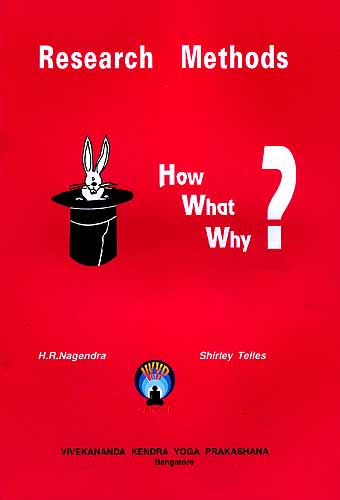
RESEARCH METHODS: How? What? Why?

| Specifications |
 |
Publisher: Vivekananda Kendra Yoga Prakashana |
| Author: Shirley Telles | |
| Language: English | |
| Pages: 45 (With B & W Figures) | |
| Cover: Paperback | |
 |
8.4" X 5.7" |
 |
Weight 70 gm |
| Edition: 1999 | |
| ISBN: 8187313110 | |
 |
IDF622 |
| Delivery and Return Policies |
 |
Ships in 1-3 days |
 |
Returns and Exchanges accepted within 7 days |
 |
Free Delivery |


Nowadays there is an increasing interest in using non pharmaco- logical ('alternative') modes of treatment for ailments which are known to be caused by stress induced changes in the mental state. However. though there is a growing awareness and interest in these treatments, they are not yet accepted by the medical community. in India or elsewhere. For this reason the clinical progress has to be systematically monitored, using methods which are acceptable the world over,
Research into the therapeutic efficacy of alternative medical treat-
ments is a very new field. This means that there is a great deal to
be done. Broadly, the there are three types of research projects -
a} Understanding the physiological effects of a treatment' by car-
rying out tests on normal, healthy volunteers.
b) Monitoring the clinical progress of two matched groups of
patients, where one group would be given a conventional treat-
ment and the other group would receive the unconventional
treatment under investigation.
c) Understanding the way in which the treatment acts. again by
carrying out tests on normal. healthy volunteers.
1. PHYSIOLOGICAL EFFECTS ON NORMAL
VOLUNTEERS
This is an important step to further the understanding about what
effects non conventional treatments may have. Many treatments
have been systematically described in ancient texts. This is spe-
cially true for yoga practices. However, many of the reported ef-
fects have not been verified by present day scientific methods.lt
would be ideal to know how these techniques modify normal physi-
ology, before using any of these techniques for therapeutic benefit.
2. MONITORING THE CUNICAL PROGRESS
All patients receiving non conventional treatment have to be carefully
monitored. The assessments should also be done on a parallel group
of patients receiving conventional treatment. The parameters should
be recorded using standard methods and under controlled
conditions. It is also important to remember that the treatments
should also be standardized so that all patients receive exactly the
same of treatment. This can be understood with an example •. ..If a
specific pranayama is 'prescribed' for a particular disease, all
patients should practice the pranayama with the same counts, for
the same amount of time.
3. UNDERSTANDING "HOW" A PARTICULAR
TREATMENT ACTS
For any unconventional treatment to be accepted by the medical
community the world over, the exact change brought about. by the
treatment has to be known.
In this report the way in which a research project is planned, and
the parameters which are conventionally employed to assess psy-
chosomatic ailments are discussed.
* = here, 'treatment' is used to convey unconventional or
alternative treatment.
| Introduction | 1 |
| Planning a research project | 3 |
| Design of the study | 7 |
| Statistics | 14 |
| Parameters to be recorded for specific diseases | 19 |
| Obesity | 19 |
| Diabetes mellitus | 22 |
| Hypertension | 25 |
| Asthma | 30 |
| Low back pain | 33 |
| Rheumatoid arthritis | 35 |
| Appendix I | 39 |

Click Here for More Books Published By Swami Vivekananda Yoga Publications









-
Q. What locations do you deliver to ?A. Exotic India delivers orders to all countries having diplomatic relations with India.
-
Q. Do you offer free shipping ?A. Exotic India offers free shipping on all orders of value of $30 USD or more.
-
Q. Can I return the book?A. All returns must be postmarked within seven (7) days of the delivery date. All returned items must be in new and unused condition, with all original tags and labels attached. To know more please view our return policy
-
Q. Do you offer express shipping ?A. Yes, we do have a chargeable express shipping facility available. You can select express shipping while checking out on the website.
-
Q. I accidentally entered wrong delivery address, can I change the address ?A. Delivery addresses can only be changed only incase the order has not been shipped yet. Incase of an address change, you can reach us at help@exoticindia.com
-
Q. How do I track my order ?A. You can track your orders simply entering your order number through here or through your past orders if you are signed in on the website.
-
Q. How can I cancel an order ?A. An order can only be cancelled if it has not been shipped. To cancel an order, kindly reach out to us through help@exoticindia.com.