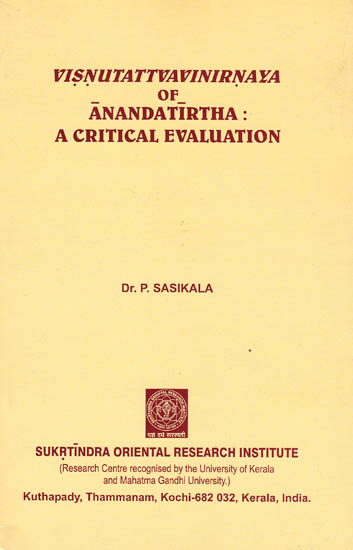
Visnutattvavinirnaya of Anandatirtha: A Critical Evaluation
| Specifications |
 |
Publisher: Sukrtindra Oriental Research Institute, Kerala |
| Author: Dr. P. Sasikala | |
| Language: English | |
| Pages: 220 | |
| Cover: Paperback | |
 |
8.3 inch X 5.5 inch |
 |
Weight 260 gm |
| Edition: 2007 | |
 |
NAB810 |
| Delivery and Return Policies |
 |
Returns and Exchanges accepted within 7 days |
 |
Free Delivery |


Anandatirtha known as Madhvacarya is the exponent of Dvaita philosophy. He has written many small treatises explaining the principles of dualism. These works are known as Dasaprakaranas. Among them Visnutattvavinirnaya is an important work dealing with the Supreme God Narayana – His divine qualities, divine body, His all-pervading nature and also His Sarvottamatva. According to Madhvacarya, Sri Visnu is Supreme God, Master of all. Individual souls are entirely different from the Supreme, and they are servants. So they can never become one. The book Visnutattvavinirnaya thus occupies a high position among the literature dealing with dualism.
Dr. P. Sasikala, Selection Grade Lecturer in Vedanta in D.B. College, Sasthamcotta, studied the work critically and on the basis of her experience gained by such study, prepared a thesis for her Ph.D. degree. I have no hesitation to say that Dr. Sasikala has done a commendable job by her criticism and her observation on the principles of dualism. Sri Sankara, Sri Madhvacarya and Sri Ramanuja are the exponents of various systems of philosophy on the basis of scriptures.
Now her thesis goes to the press for publication. I am sure the thesis will be a guide to the future researchers who are interested in studying and understanding Anandatirtha’s principles of dualism. I hope the researchers and other scholars in the field of Indian philosophy will welcome the work. I wish Dr. Sasikala all success.
Preface
The contribution of South India to the treasure of Indian philosophy, especially Vedanta philosophy, is remarkable. The three main systems of Vedanta have their origin in the southern states. Advaita which chronologically comes first was systematized by the great teacher Sri Sankaracarya who was a native of Kerala. Sri. Ramanujacarya of Tamilanadu made Visistadvaita into a philosophical system. Anandatirtha or Madhvacarya, the propounder of the Dvaita system of thought was a native of Karnataka. Among these systems Sankara’s philosophy acquired world-wide popularity. Whereas the other two were confined to certain areas of the country. The Dvaita system of thought could not attain a notable place in the scholarly minds of Kerala as the Advaita system did. It may be due to the great popularity of the Advaita philosophy. While a large number of studies have been done in Advaita, the studies in Dvaita are comparatively less in number. This work is the result of a humble attempt to understand the doctrines of Dvaita philosophy in the light of one of the works of Anandatirtha, the great propounder and teacher of the system. The Dvaita philosophy is exclusively the contribution of Karnataka.
Being a student of Advaita I was much interested, when I went through Madhva’s work Visnutattvavinirnaya which is a critique of Sankara’s philosophy. This work of Madhva contains a brilliant criticism of Sankara’s interpretation of the Upanisadic passages. I hope this study on Madhva’s work will be useful to the students of Vedanta.
This work has entitled me to the award of Ph.D. Degree from Sri Sankaracarya University of Sanskrit, Kalady. My teacher and guide, (Late) Dr. Poovattoor Ramakrishna Pillai, former Principal, D.B. College, Sasthamcotta and former Campus Director of the Regional Centre, Sri Sankaracarya University of Sanskrit, Thiruvananthapuram, has always encouraged me to publish the thesis. He was the guiding spirit behind my success. I express my everlasting indebtedness to him. I owe my sincere thanks to Professor R. Vasudevan Potti, Former Dean of the Faculty of Indian Metaphysics, Sri Sankaracarya University of Sanskrit, Kalady, who spared his valuable time to write a foreword to this book and the help rendered to me always.
I express my deep sense of gratitude to Smt. C. Chandramathy, Professor. Dept of English (Rtd.), Devaswom Board College, Sasthamcotta, for patiently going through this work and giving valuable suggestions.
I am grateful to Sri Sankaracarya University of Sanskrit, Kalady, for providing me the facilities for this research work and giving me sanction to publish the thesis. I am also thankful to Dr. P. Chithambaran, Professor and Head of the Department of Vedanta, Sri Sankaracarya University of Sanskrit, for his help and valuable suggestions.
My thanks are due to all those who inspired me with advice and assistance in the course of this work.
I owe special thanks to Sukrtindra Oriental Research Institute, Kochi, for including this work in their Indological Series.
| Foreword | iii | |
| Preface | ix | |
| Contents | vi | |
| Abbreviations | xi | |
| CHAPTER I | INTRODUCTION | 1 |
| Advaita Philosophy | 6 | |
| Visistadvaita | 8 | |
| Dvaita Philosophy | 9 | |
| Origin and Development of the Dvaita System | 11 | |
| CHAPTER II | LIFE, DATE AND WORKS OF MADHVACARYA | 21 |
| Life | 21 | |
| Date | 26 | |
| Works | 26 | |
| Commentary on Vedic Hymns | 27 | |
| Commentaries on Upanisads | 28 | |
| Commentaries on Brahmasutra | 32 | |
| Commentaries on Epics and Puranas | 33 | |
| Independent Works | 35 | |
| The Stotras, Poems and Other Works | 38 | |
| CHAPTER III | CONTENTS AND COMMENTARIES OF VISNUTATTVAVINIRNAYA | 45 |
| Contents | 45 | |
| First Pariccheda | 45 | |
| Vedas and Their Apauruseyatva | 47 | |
| Self-validity of Knowledge | 47 | |
| Eternity of Varnas and Vedas | 47 | |
| The Theory of Siddhe-vyutpatti | 48 | |
| Pramanas | 49 | |
| Bhedasrutis and Their Superior Nature | 52 | |
| Supremacy of Lord Visnu | 53 | |
| Vindication of Difference | 54 | |
| Refutation of Mithyatva | 56 | |
| The Interpretation of the Passages in the Sixth Chapter of Chandogyopanisad | 58 | |
| Dvaita Concept of Maya | 58 | |
| The Five-fold Difference | 59 | |
| The Passages from Other Upanisads | 59 | |
| The Refutation of Advaitin’s Avidya Concept | 60 | |
| Second Pariccheda | 61 | |
| Third Pariccheda | 63 | |
| Liberation | 64 | |
| Gradation in the Enjoyment of Bliss | 64 | |
| Commentaries | 65 | |
| Translations of VTV | 67 | |
| Study of the Work | 67 | |
| CHAPTER IV | THE TITLE OF THE WORK, THE SADAGAMAS AND THEORY OF APAURUSEYATVA | 70 |
| Title of the text | 72 | |
| Visnu | 72 | |
| Tattva | 74 | |
| Vinirnaya | 75 | |
| The Sadagamas | 75 | |
| Vedas and Pancaratras | 76 | |
| Mularamayana | 76 | |
| Puranas | 77 | |
| Mahabharata | 78 | |
| Madhva’s Theory of | ||
| Apauruseyatva of Vedas | 78 | |
| A Philospher in Madhva’s View | 80 | |
| Dharma | 82 | |
| Repudiation of Carvaka’s Theory | 83 | |
| Eternity of Varnas | 84 | |
| Eternity of Vedas | 86 | |
| CHAPTER V | EPISTEMOLOGY AND VINDICATION OF DIFFERENCE | 92 |
| Dvaita Epistemology | 92 | |
| Pramanas | 92 | |
| Madhva’s theory of Sentence | ||
| Communication | 99 | |
| Relative Strength of Pramanas | 100 | |
| Self-validity of Knowledge | 102 | |
| Doctrine of Saksin | 103 | |
| Memory | 104 | |
| Madhva’s Theory of Error | 105 | |
| Vindication of the Doctrine of Difference | 107 | |
| The Term Dvaita | 107 | |
| Nature of Difference | 110 | |
| Visesa | 111 | |
| The Five-fold Difference | 113 | |
| Ontology | 114 | |
| Advaita View of the World and Its Refutation | 116 | |
| CHAPTER VI | MADHVA’S INTERPRETATION OF THE PASSAGES FROM CHANDOGYOPANISAD | 122 |
| Tattvamasi | 122 | |
| Svam hyapitah | 132 | |
| Sanmulah somyemah sarva prajah sadayatanah | 133 | |
| Jivenatmana anupravisya | 133 | |
| The Words Anima and Anvah | 134 | |
| The Word Aitadatmyam | 135 | |
| Ekavijnanena Sarvavijnanam | 138 | |
| The Vacarambhana Passage | 142 | |
| CHAPTER VII | MADHVA’S INTERPRETATION OF THE PASSAGES FROM OTHER UPANISADS | 149 |
| Aham Brahmasmi | 149 | |
| Yatra tvasya sarvamatmaivabhut | ||
| Tatkena kam pasyet | 151 | |
| Natu tadvitiyamasti | 154 | |
| Karmani Vijnanamayasca pare avyaye Sarva ekibhavanti | 157 | |
| Brahamaveda brahmaiva bhavati | 159 | |
| Prapanco yadi vidyeta | 161 | |
| Interpretation of the Term Maya | 165 | |
| CHAPTER VIII | VINDICATION OF REALISM | 172 |
| Advaita Theory of Maya | 172 | |
| Ekajivavada and Its Refutation | 179 | |
| Bahujivavada and Its Refutation | 181 | |
| Criticism of the Theory of Inexplicability of Maya | 183 | |
| Repudiation of Nairatmyavada | 185 | |
| Repudiation of the Concept of Saguna and Nirguna Brahman | 186 | |
| Madhva’s Comparison of Mayavada with Sunyavada | 188 | |
| Madhva’s Concept of Maya | 190 | |
| Individual Soul in Dvaita | 190 | |
| Gradation of the Individual Souls | 192 | |
| Means of Liberation | 193 | |
| Liberation | 194 | |
| Gradation of Bliss | 195 | |
| Brahman in Dvaita | 195 | |
| CHAPTER IX | CONCLUSION | 202 |
| SELECT BIBLIOGRAPHY | 210 |

-
Q. What locations do you deliver to ?A. Exotic India delivers orders to all countries having diplomatic relations with India.
-
Q. Do you offer free shipping ?A. Exotic India offers free shipping on all orders of value of $30 USD or more.
-
Q. Can I return the book?A. All returns must be postmarked within seven (7) days of the delivery date. All returned items must be in new and unused condition, with all original tags and labels attached. To know more please view our return policy
-
Q. Do you offer express shipping ?A. Yes, we do have a chargeable express shipping facility available. You can select express shipping while checking out on the website.
-
Q. I accidentally entered wrong delivery address, can I change the address ?A. Delivery addresses can only be changed only incase the order has not been shipped yet. Incase of an address change, you can reach us at help@exoticindia.com
-
Q. How do I track my order ?A. You can track your orders simply entering your order number through here or through your past orders if you are signed in on the website.
-
Q. How can I cancel an order ?A. An order can only be cancelled if it has not been shipped. To cancel an order, kindly reach out to us through help@exoticindia.com.