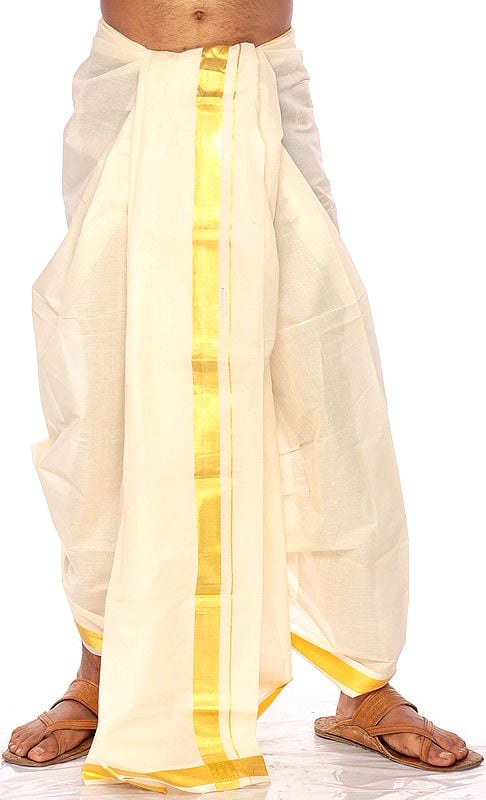

This
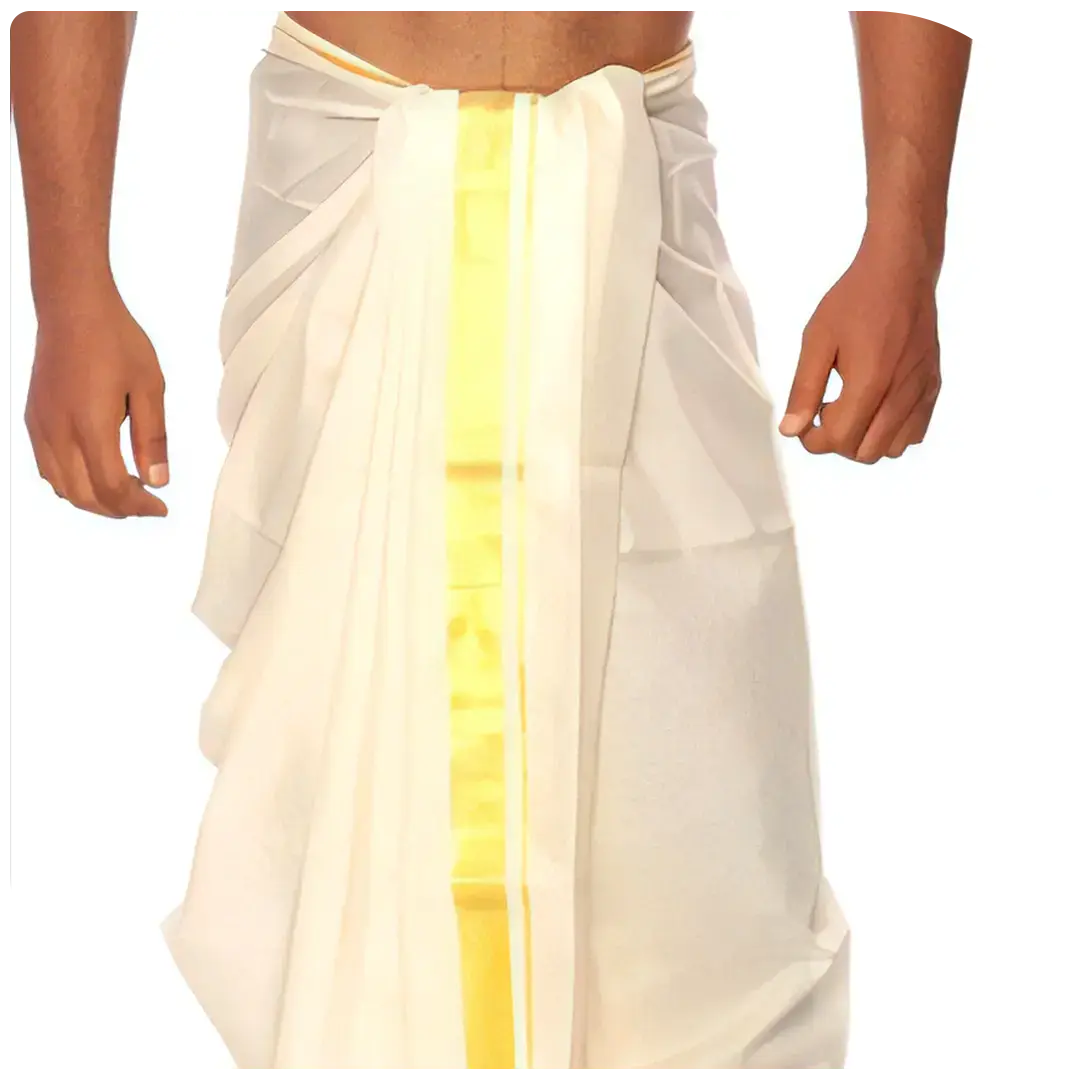
exquisite off-white dhoti from Kerala is a captivating blend of traditional
Kasavu style and elegance. Kasavu the traditional handloom from Kerala is a
woven fabric with golden borders. Initially, the golden border was made with
gold threads. Crafted with meticulous care, this dhoti features a pristine
snow-white fabric adorned with a wide golden border, adding a touch of regal
charm, making it a perfect fit for formal occasions or cultural celebrations.
The Male Dhoti
This unstitched textile length, a pure cotton fabric in eye soothing cream tint, lustrous zari border and end-bands, a component of male ensemble ‘dhoti’ is one of earliest classes of textiles in use since at least the Mauryan era – fourth-third century BCE. Besides its luxurious look and all its magic revealing in its sheen, this style of ensemble emits some kind of ritual sanctity. A priest’s wear an unstitched length of textile that a dhoti essentially is since the Indus days a dhoti is a ritual garment, no rite accomplished unless its performer is in dhoti. In South Indian shrines, to include those in Kerala as also Andhra, only one wearing a dhoti is allowed entry. This dhoti with fine zari work is typical of South Indian temple goers. The zari is synthetic; however, with its rare finish and fibre’s fine quality it has the beauty and elegance of pure gold wire.
Forbes Watson, in his book published in 1866 defined Indian costume as 'leave the loom' and are 'ready for wear'. The same as Alberuni, an eleventh century scholar from Central Asia, who was in India from 1017 to 1030 A D, had observed that Indian natives used 'turbans for trousers'. Both referred to a dhoti, a simple unstitched length of textile that at times could be laid over the shoulder as an ‘anga-vastram’, and at times, as turban. Alike, this piece of textile, though manufactured as dhoti, is often seen worn also on shoulders. As suggests the steatite figure of the famous Indus priest wearing a textile length down to his waist, and another, on his shoulder, the cult of adorning a textile length with various design-patterns has persisted ever since. This dhoti seeks to adorn it in brilliant zari.
This dhoti, a four meters unstitched length as are invariably the dimensions of a dhoti, is woven from fine pure cotton in soft cream tint and defined with brilliant zari with gold like lustre. A class of textile getting obsolete except in rural belt, among nobility and priestly class a dhoti is a ritual ensemble now for ages. Craving for novelty and to look different in a marriage or when celebrating a festival urbanized youth of society’s upper strata are also seen wearing a richly crafted dhoti. Even in a large crowd a dhoti has phenomenal presence.
This description by Prof. P.C. Jain and Dr Daljeet. Prof. Jain specializes on the aesthetics of ancient India. Dr Daljeet is the chief curator of the Visual Arts Gallery at the National Museum of India, New Delhi. They have both collaborated on numerous books on Indian art and culture.
Wrapping Culture: The Art of Wearing a dhoti
Dhoti is an unstitched garment or a large fabric, measuring about
5 yards in length, that is wrapped by men around their waist and
legs. In Vedic civilization, wearing Dhoti was a part of their
everyday attire. However, modern civilization has changed the
clothing styles and preferences of Indian men and women. Indians
have now imbibed the western culture. That being said, one cannot
ignore the fact that some sections of men can still be seen
wearing dhotis such as the farmers of Uttar Pradesh and Bihar,
some secular politicians, the pujaris or priests in Hindu temples,
and some traditional martial artists. It is undoubtedly the emblem
of the unmatched Indian culture. Dhoti is called by different
names in different places such as "Mundu" in Kerala, "Laacha" in
Punjab, "Mardaani" in Uttar Pradesh and Bihar, "Veshti" in Tamil
Nadu, "Dhotar" in Maharashtra, etc.
Draping a perfect Dhoti: The neat and comfortable way
Tying a perfect dhoti is not a difficult task and can be wrapped
in various ways. If you want to experience the comfortable drape
of the dhoti, you need to know how to wear the dhoti in the
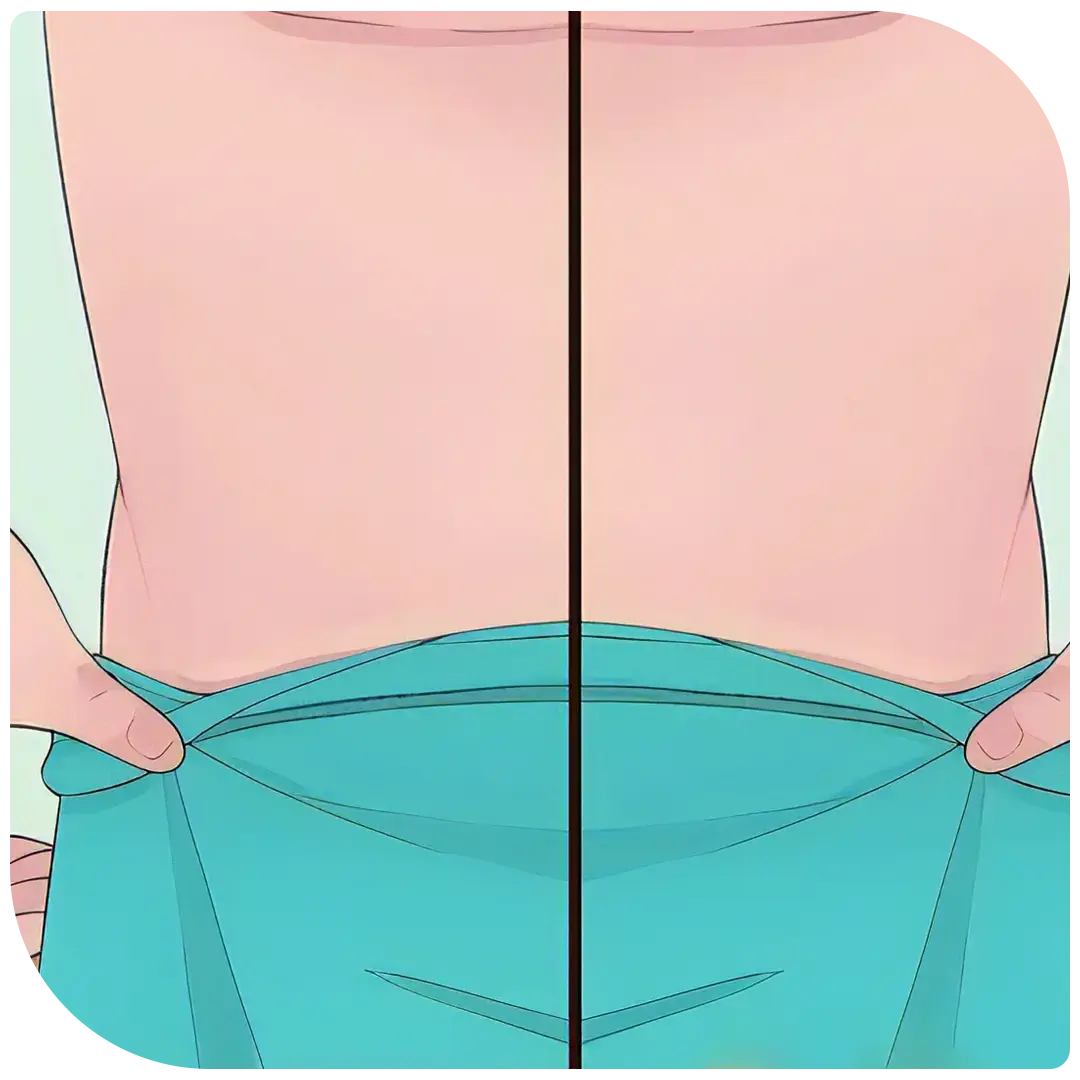
simplest way, the steps of which are mentioned below:Step 1 - Bring the cloth to the front
Take a long piece of unstitched cloth of your choice. Make sure
it is clean and does not have any wrinkles on it. Bring the
cloth from the back to the front on the waist so that there is
the same length of the cloth on either side of your body.

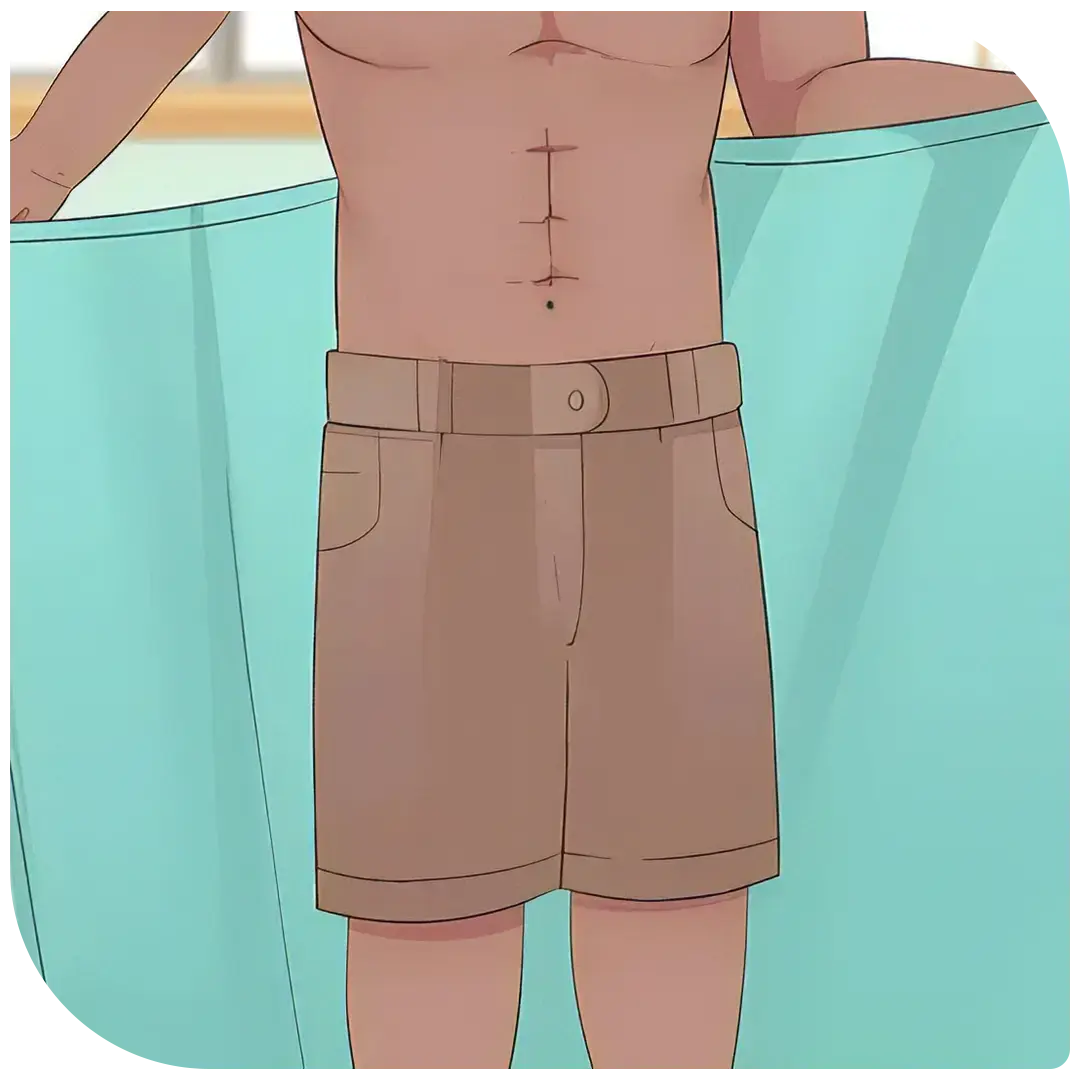
Step 2 - Tie knots to keep the cloth in place
Measuring on both your index fingers, tie two knots near the
navel. The knots should neither be too tight nor too loose on
your waist. Now the cloth is divided into two sections; left and
right.
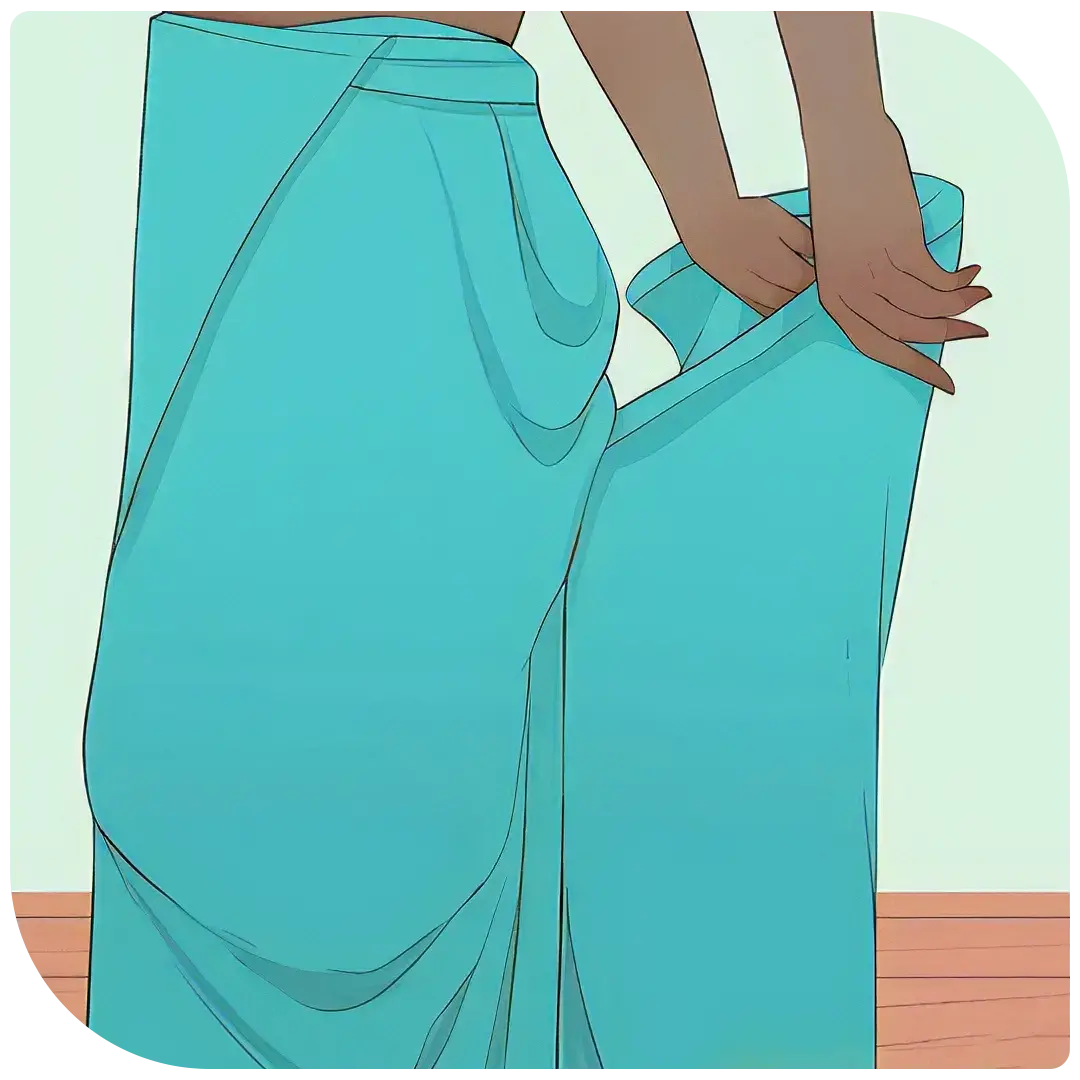
Step 3 - Set pleats on the left side
Take the left section from between your legs. Make a series of
structured and aligned folds between both the loose ends, and
tuck it at the back. Remember, it is the way the folds have been
set that makes the dhoti look elegant.
Step 4 - Make folds on the right side
Now that the left section is set, it is time to work on the
right section of the cloth. You have to make similar pleats on
this side too and make sure that they remain intact. Now tuck it
at the waist and your dhoti is ready.
Different ways of styling Dhoti
The lightweight cotton fabric of the dhoti is available in
various colors having a stripe of a colorful border making it
appear rich and sophisticated. This clothing is suited
especially for the summer season. A lot of innovations have been
made to the Dhoti, one of them being its availability in silk
fabric also. The silk varieties are worn on special occasions
and marriage ceremonies, while the cotton varieties are worn as
daily wear. The Indian dhoti is not only extremely comfortable
for men but also adds an element of dignity and manliness to
their personalities. The way of styling the Indian dhoti differs
from place to place and has indeed evolved a lot due to global
influence.
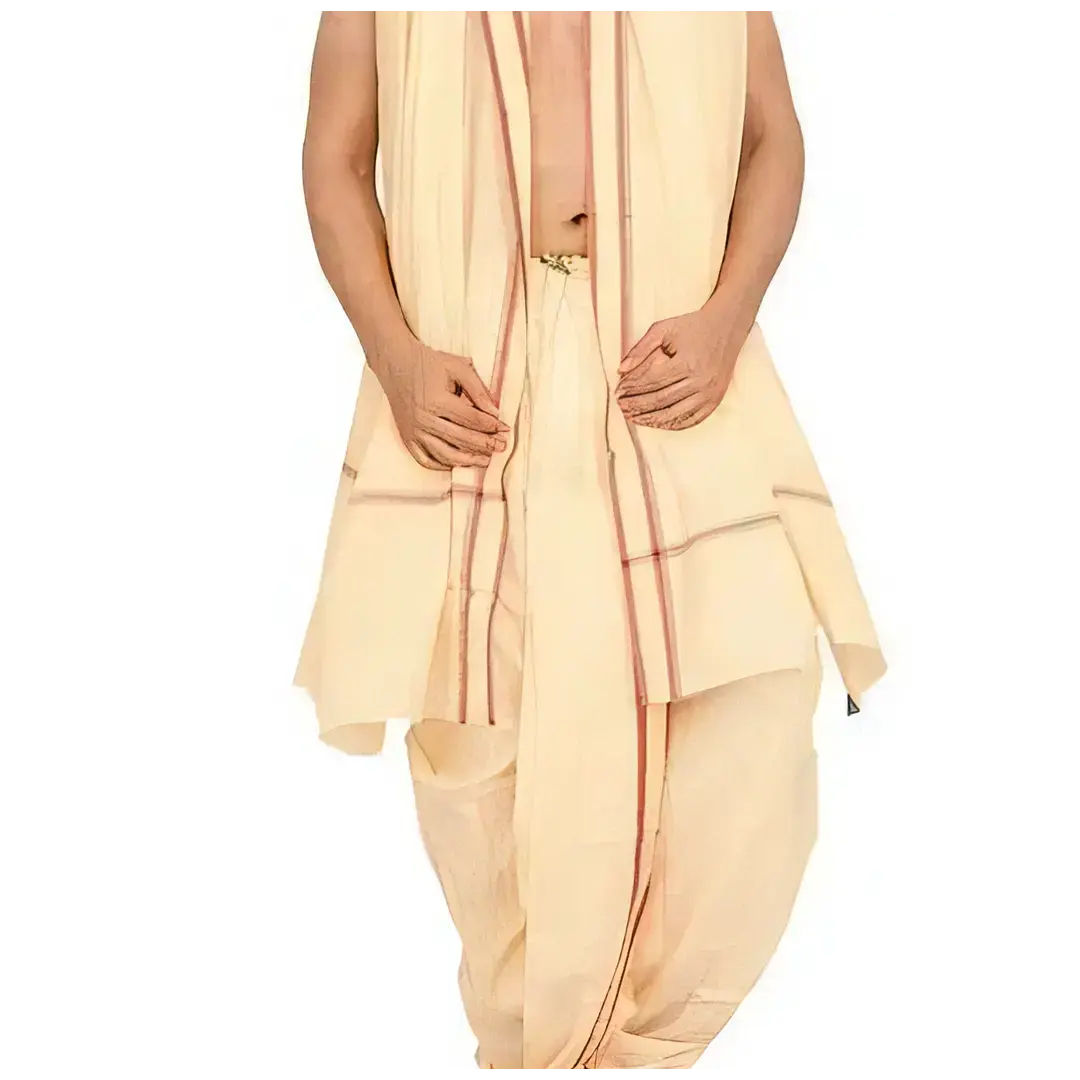
In the South Indian states men either fold their dhoti into half
and tuck it at the waist reaching only to their knees which is
mostly worn on informal occasions, or a full-length dhoti which
is mostly plain white bearing a golden border. They wear it with
an unstitched piece of cloth known as “Angavastram” draped over
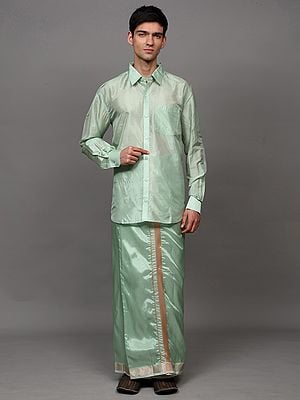
their shoulders. Some men wear the dhoti along with a shirt
which they call a “Chokka”.

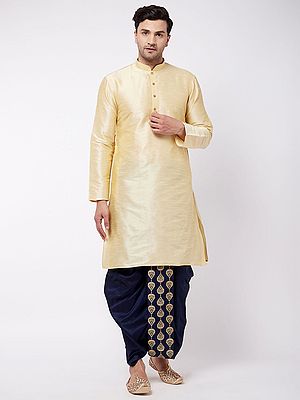
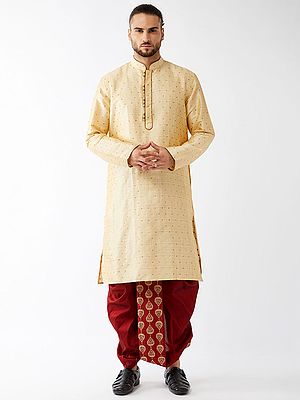
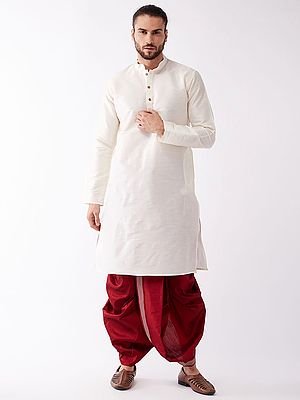
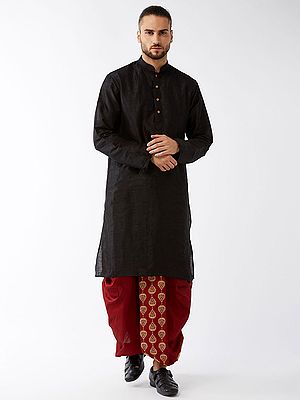
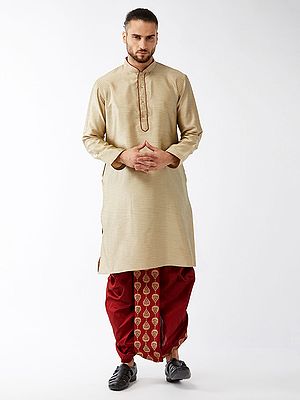
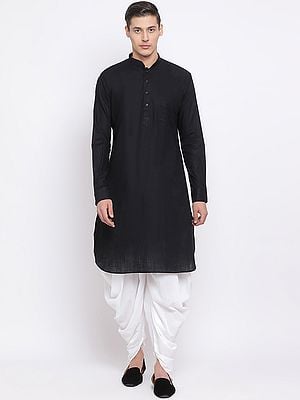
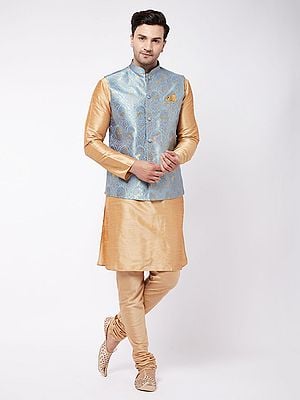
Men in North India style their dhoti with a Kurta and the
combination is called “Dhoti-kurta”. Men of the “Jaat” community
of Haryana are also seen clad in Dhoti Kurta.
Traditional men of West Bengal wear a Dhoti made of Tussar or
Silk along with a Kurta on the festivity celebrations of Durga
Puja and Saraswati Puja.
The Gaudiya Vaishnavas or the devotees of the worldwide-known
Hare Krishna Movement have positively adopted the Vedic culture
of wearing Dhoti as their everyday attire. The Brahmacharis wear
saffron colored dhoti along with saffron Kurta while the
Grihastha men wear white colored dhoti along with white Kurta.
Some unmarried boys pair their dhoti with a simple T-shirt or
collared shirt making it look more like a fashionable garment.
The youth of this movement inspires others to reconnect with the
rich tradition and culture of Bharat due to which wearing a
dhoti has gained a lot of popularity.