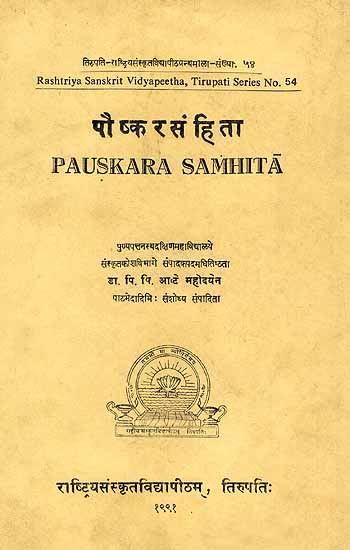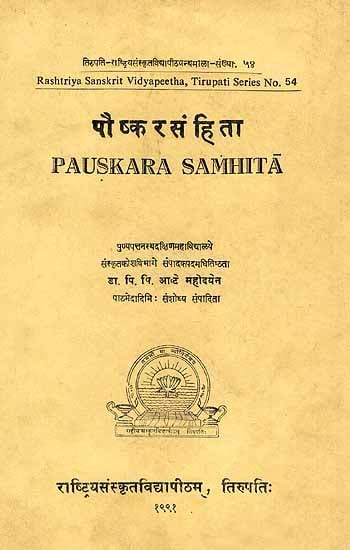
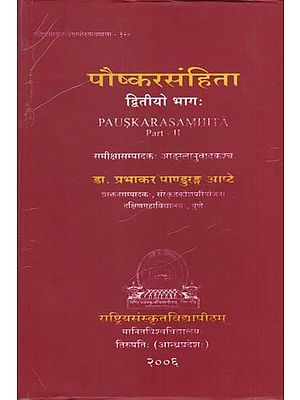
Pauskara Samhita (In Two Volumes): A Rare Book - Sanskrit Text with English Translation
| Specifications |
 |
Publisher: Rashtriya Sanskrit Vidyapeetha, Tirupati |
| Author: Dr. P. P. Apte | |
| Language: Sanskrit Text with English Translation | |
| Pages: 1493 (21 B/W Yantras Figures) | |
| Cover: Hardcover | |
 |
10.0" X 6.8" |
| Edition: 1991 | |
 |
IDL172 |
| a50_books |
| Delivery and Return Policies |
 |
Returns and Exchanges accepted within 7 days |
 |
Free Delivery |


In the Fourth Meeting of the Publication committee of Rashtriya Sanskrit Samsthan held on the fifth June 1976 at New Delhi, it was resolved that materials from the three Agamas-Vaikhanasa, Pancaratra and Saiva-should be collected and placed before the Publication Committee for compiling the Agama Kosa.
In early 1968 when I joined the Tirupati Vidyapeetha as Reader and Head of the Research and Publication wing, I observed that the material extracted from Pancaratra Samhitas for the Agama-Kosa, contained dubious readings and consequently the critical editions of the important text have to be undertaken by that wing. Dr. B.R. Sharma, the then Director suggested that critical editions of the Visvamitra-, and Pauskar-Samhitas might be brought out by the Research wing. The last mentioned Samhita was assigned to Dr last mentioned Samhita was assigned to Dr. P. P. Apte (the then Lecturer in the wing). Its publication was approved in a meeting of a publication committee 3-2-1986.
That in view of the importance of the Pauskar-Samhita in the Pancaratra-Canon, Critical edition of the text is a pressing need, was candidly admitted by H. Daniel SMITH in an article entitled, “The three gems of the Pancaratra-Canon-an appraisal” published in Vol I, Part I of the Vimars’a (pp. 45-51) of the K.S. Vidyapeetha (Tirupati 1972).
The Pauskar-Samhita (hereafter abbreviated to PS) contains about 5900 slokas, divided into 43 chapters, and it runs as a dialogue between Pauskara and Bhagawan on the technique of marshalling the Mandala designs and their significance in the first 26 chapters.
In this edition, Dr. APTE has utilized two Mss of PS-one from India office Library London and the other Supplied to him by Asuri Srinivas Ayyengar, who after entering into the Sanyasa-order is now known as HH Sri Yatiraja Sampatkumar Ramanjua Muni of Melkote.
The affiliation of the Pauskara-Paramesvara to Srirangam temple in the south, is obviously known from the Jayakhya (12cd) citation.
Srirange Pauskaram tatha l
To put it particularly, the worship of Hari is carried out in accordance with Satvata-Isvara in Melkote, Pauskara-Parameshvara in Srirangam and Jayakhya-Padma in Kanchi.
Dr. Apte is specially qualified to undertake the responsibility of ending the PS because of his qualifications, training and experience, He obtained a doctorate degree in the Pancaratra, from the university of Poona, worked for about three years in the Agama Kosa wing of the Tirupati Vidyapeetha as Lecturer and attended several Agama conferences organized by the illustrations sage of Kanci at several temple centres in Kanci and other centres in Andhra Pradesh.
I trust the text of PS with its simple translation will go a long way to whet the appetite of students of temple religion in general and Vaisnavism in particular.
Introduction
An attempt has been made to reconstruct the scheme of 25 Mandalas described in ‘Pauskara Samihita’ of the Pancaratra Agama. ‘Pauskara Samhita’ is one of the three main canonical ‘samhita’ texts of the Pancaratra doctrine-a Vaisnavite religious sect in India. The three classical Samhitas of the Pancaratra Agama are: Sattvata Samhita, Pauskara Samhita and Jayakhya Samhita, and these texts date back to 3rd to 5th Century A.D.
Though mandala worship is described and mentioned in all three texts, it happens to be the central theme of ‘Pauskara Samhita’ – which describes in great details the technical construction of the mandalas to be drawn for the purpose of ‘Mandalaradhana’ (Mandala worship) as part of the initiation and progress of the spiritual aspirant seeking admission to the cult, with the final aim of attainment of Moksa.
The Pancaratra religious sect is still one of the important religious sects in the South India, however, the elaborate procedure of ‘Mandalaradhana’ as an independent institution as described in Pauskara Samhita has been relegated to the background in the course of centuries and forgotten.
The present reconstruction of Pauskara Samhita mandalas with the help of original textual description represents an important addition to the literature regarding ‘Mandala’ worship, as the date of Pauskara Samhita makes them among the oldest mandalas in the world.
IN PANCARATR AGAMA
India has been a land of cultural interactions and integrations. The heritage of the Vedic tradition was supplemented by Tantric and local traditions in the religio-cultural field of social life, in addition to the influences of Buddhism and Jainism etc. the Moksa-dharmaparvan of the ‘Mahabharata’ has stored encyclopaedic information on various religious sects Saiva, Pancaratra, Pasupata etc. the Pancaratra docrine believing in one and only God ‘Visnu’ and instructing the Satvata mode of worship has occupied an important place in this parvan being allotted a separate Narayaniya section for this cult variously named as Ekantidharma or the Sattvata or Bhagavatavidhi. The Gita verses ‘Imam Vivasvate yogam’.. (4.1-7) apparently refer to this Ekantidharma tradition. This tradition seems to have developed into the temple-oriented phase of the Pancaratra in the post-Mahabharata period. An integrated scheme of worship called ‘Catuh-sthana-arcana’ came to be accepted in the temple religion. This scheme includes in addition to the image worship invocation and worship in Kumbha (water-pot), Mandala (mystic diagram), and Kunda (fire-pit).
Mandalas are said to be mystic diagrams-mystic in the sense they are used in a mystic way or for a mystic purpose often connected with tantrism. The diagrams known as Yantra-Cakra-Bhadra etc. form an allotropy of mystic symbolisms of which Mandala is one.
The Mandala worship is found prescribed in all the three classical samhitas of the Pancaratra Agama: Sattvata, Pauskara and Jayakhya of 3rd to 5th Century A D That the worship of God with the aid of mystic diagrams was incorporated in the Pancaratra ritualism from its earliest phase is evidenced from the canonical text Sattvata Samhita referring to a wheel inscribed with mantras (mantra-cakra) in 2:12. It explains further a form of worship in the mandala diagrams (Mandlaradhana). It is quite likely that this practice was adopted in the Pancaratra religion from tantric tradition. But soon after adoption in the Pancaratra family, it has been fully and finally Vaisnavised and has developed and maintained its personality as such with sectarian characteristics all along.
The scheme of Mandalas happens to be the central theme of the Pauskara Samhita. The temple institution having a very firm footing in the South India owes allegiance to the classical Samhitas of admittedly, northern origin especially in Kashmir.
The Vaisnavism apparently remodeled the tantric elements of Mantras, Mandalas and Mudras to suit their inherent tenets and practices. The Pauskara Samhita reflects the clarity of vision of the Pancaratra seers evolving the scientific and elaborate scheme of Mandalaradhana which might be said to be a prototype of Alayaradhana or the temple-worship later on incorporating and preserving the mandala-worship along with the Agni and Kumbha worships under the ‘Catusthanarcana’ curriculum of rituals.
For understanding the topic of Mandalas, the Pauskara Samhita (PS-c. 300-400 (A D) which is next in authority to Sattvata Samhita (SS) is extremely important, since it elaborates the technical aspect of these diagrams and serves as a source book for later Pancaratra religion, on the subject of Mandalaradhana-Jayakhya Samhita (JS) the third canonical text also gives one specimen: Navapadmamandala and the rest of the Samhitas post classical and later ones describe one or more such diagrams. The Pauskara Samhita is of special value because here one gets a detailed scheme of sketching, designing and colouring of the Mandalas.
The place of Mandala worship in the historical Pan-caratra religion especially the temple cult in South India is as an important component of the fourfold worship offered to God who is invoked in image, pitcher, mandala and fire (Bimba, Kumbha, Mandala and Agni). From PS, however, it appears that the Mandala worship, in those davs was not a part of the temple ritual only, but often maintained its independent existence like the sacrificial institution. And for that ritual known as Yaga, a special pandal was erected on a site chosen on a mountain or in a forest or by the side of a hermitage or on the bank of a river or inside temple premises (PS 2.4.5.). The formal purpose of the Mandalaradhana is the initiation and progress of the spiritual aspirant seeking admission to the cult and the final goal is obviously the attainment of Moksa. PS (Chapter I) prescribes four main classes of Mandalas: Padmodara or lotus hearted, Aneka-kajagarbha or multi-lotus, Cakrabja or lotus-surrounded-by-circle, and Misracakra or of complex-wheels. These are meant for aspirants passing through various grades of progress: Samayi, Putraka, Sadhaka and Acarya. The aspirant practices some sort of Yogic-cum tantric process of self-restraint with the help of the diagrams aiming at the final liberation. It is assured that the aspirant by entangling himself in these diagrams really frees himself of all bondages. The merit of the Mandalaradhana accrues by even witnessing, worshipping it or meditating upon it. These Yagas continue for a period extending up to forty days or more.
At a later stage, the human tendency to utilize the mysterious powers for personal visible benefit seems to have outweighed the urge for spiritual uplift and the Mandala worship was yoked for mercenary ends as seen from Sriprasna Samhita (52:56-63). The diagrams were sometimes drawn on canvas or wall instead of being drawn on the ground.
The elaborate procedure of ‘Mandalaradhana’ as an independent institution has gradually been relegated to the background in the course of time. The Pauskara Samhita which has been preserved as an article of faith has suffered a lot in faithful preservation as an article of faith has suffered a lot in faithful preservation of the portions dealing with the technical niceties of sketching and colouring of elaborate patterns of complicate geometrical descriptions.
Both the approaches, the grammatical of the Sanskritist or the geometrical of the technologist often fall short in interpreting these passages. All the same persistent efforts by researchers do yield valuable results. It is felt that this chapter of our rich cultural heritage revealed by this interpretative methodology would interest the scholars and designers alike.
Foreword Blessing
We are happy that the second part of Pauskarasamhita (Chs. 27 - 43) is being published, alongwith English translation done by Dr. Prabhakar Pandurang Apte. We are more happy about the revised elegant format of the book placing Sanskrit verses and English translation of the same. It is also praiseworthy that the editor has made much progress over our first Devanagari edition published in 1934. At that time due to numerous Granthapatas which could not be filled in spite of our efforts to collect and collate available palm leaf manuscripts in Grantha character, we had to print the text with gaps. We are happy that the present editor has succeded in filling in hundreds of lacunae on the strength of his deep penetration into content-analysis. He has used square brackets to indicate that the gaps have been filled by him after giving due consideration to contextual content. This kind of labour on the part of the editor is approved by Jayakhya Samhita (c. 450 A.D.) following words: Pranasta-Pathavakyanam Krtva Vastuvicaranam… prayatnat samskaroti vai. We had given our blessings to the publication of first part in 1991. We are happy that the research in Pancaratra started with the publication of Ahirbudhnya samhita critically edited by F. Otto Schrader continues in 1916. We very well know the hardship undergone by the pioneers of Pancaratra research. When Schrader wrote his ‘Introduction to Pancaratra and Ahirbudhnya Samhita’, he was interned as political prisoner in Ahmadnagar Jail. The proofs were being sent to him for correction. The intellectual contribution of that jail was made known to the world only after thirty years when Discovery of India by late Pandit Jawaharlal Nahru was written there. When we had written a letter to Schrader, making some querries about Pancaratra research, he had written to us that he was leading miserable days at the fag end of the life. We felt sad to read the line that it was difficult for him to get food even once in two days. We have personally witnessed the hardships experienced by our Guruji, H.H. Yadugiri Yatiraja Ramanuja muni, for our Pauskara samhita in Devanagari, we had to purchase Nagari fonts from Nirnayasagar press, Bombay and train the compositors to use them in Madras press. We had also purchased tradle machine and operated it in Yatiraj Math, Madras and spread the papers to dry them on the floor. We are including this account in our foreward so that the computer generation should know the evolution and growth of printing technology in Sanskrit publications.
We appreciate the efforts put in by the editor and translator as well as publishers in bringing out this valued publication. In the first part sketching, colouring and mode of worship of Mandala diagrams was special contribution. In the second part Vaisnava Sraddha procedure supplemented by deep philosophical layers, the Pavitrarohana ritual, the scientific philosophical layers, the Pavitrarohana ritual, the scientific philosophical basis of Tirthaksetras and Tirthayatras, the significance of various endowments: Vidyapitha Pratisthana etc. and the role of Sthapati in temple building and renovation activity are special contributions. The editor has done fair justice to these topics in his translation. Our blessings to both editor and publishers.
About the Author
The Author who holds a masters degree in Sanskrit and law and a doctorate in Agamas, is specially qualified to edit the text, in view of his qualifications, training and experience in the field of his specialization-i.e., Agamashastra. He has worked for three years in the Agama Kosha wing of the Tirupati Vidyapeetha. He has not only attended several Agama conferences, and national and international conferences but also presented several original papers on various aspects of Agamas. He has to his credit several research papers published in renowned Indological journals. He holds at present the position of Editor of the Encyclopaedic Dictionary of Sanskrit on Historical Principles of the Deccan College, Pune.
Foreword
It is a matter of great pride and privilege that the Rashtriya Sanskrit Vidyapeetha, Tirupati is going to bring out the Volume – II of “Pauskara Samhita” with the help of the editorial craftsmanship of Prof. Prabhakar Pandurang Apte as well as the constant efforts of the Research and Publication Department of our University. The first Volume of “Pauskara Samhita” was published by the Vidyapeetha in the year 1991 and the same has been well received by the scholars and Researchers. In fact the wide appreciation of the 1st Volume by the world of scholars has prompted us to bring out the Volume II to cater to the needs of those interested in temple culture, Art technology and various rituals under Pancaratra canon.
It is well known that out of three Agamas, i.e. Vaikhanas, Pancaratra and Saiva; the Pancaratra Agama plays a dominant role particularly in South India, so far as performance of various rituals in the temples of this part of country is concerned. There are three gems of classical Samhitas of the Pancaratra Agama i.e. (i) Sattvata Samhita, (ii) Pauskara Samhita, (iii) Jayakhya Samhita and these texts were composed in between 3rd to 5th century A.D. Pauskara Samhita describes in detail the technical construction and colouring of Mandalas to be designed for the purpose of “Mandalavadhana”; an effective measure for attainment of salvation. Hence, “Pauskara Samhita” is not only considered as an authority on Vaisnavism in terms of performance of various types of rituals in the temples but also as a treatise relating to the unique Art. Technology of ancient India. The authority of the text is evident from the fact that so many propounders and exponents of Vaisnavism including Yatiraja Ramanuja have off-quoted “Pauskara Samhita” to substantiate their views and theories.
Needless to mention that a Puja (worship), if performed as per the procedures laid down in an authentic treatise, is bound to fetch good results and merits for the “Yajaman” and the same helps strengthen the mental and spiritual power by generating an atmosphere of peace and tranquility around us. That is the reason why the Sastras have been considered significant and any deviation from the scriptural prescriptions may be counter-productive. So says Srimad Bhagavad Gita.
N S Sididhimvaproti n such n para gatim II
Tasmachcghhastra praman te karyakaryavyavasithtou I
Jhatva shastrvidhanokta karm kartumiharhsi II
Not only for marshalling the Mandala designs; but also for understanding the underlying spirit and significance of Vaisnava culture of the country, the Sastras like “Pauskara Samhita” are very much essential for the mankind and relevant to the society. Even in the modern era of science and technology the significance of these ancient Sastras, based upon eternal truths and time-tested experiments, can not be ruled out. Hence, there is a dire necessity of exposition, promotion, comprehension and publication of these ancient treatise like “Pauskara Samhta”
May I avail this opportunity to express my deep sense of gratitude to those including Dr. V. Jaddipal, Head of the Department and Prof. Prabhakar Pandurang Apte and others, but for whose intellectual exercise, the concerned volume could not have seen the light of the earth and I hope that the concerned volume will be well-received as the part 1st by the scholars, researchers, readers and others interested in the Vaisnavism.
| TABLE OF CONTENS CH. I DISCIPLES’S TEST (vv. 1-54 pp. 1-9) | ||
| 1 | Disciple-Teacher Dialogue | 1-5 |
| 2 | Classification of Mandalas | 6-15 |
| 3 | Mandala Worship | 16-25 |
| 4 | Fruit of Mandala Worship | 26-32 |
| 5 | Initiation and Imparting of Knowledge by the Teacher | 33-44 |
| 6 | The fate of premature death before completion of worship | 45-54 |
| S. No | Topic | Verse No. |
| 1 | Selection of Site for Mandala Worship | 1-8 |
| 2 | Merits and defects of the Soil | 9-16 |
| 3 | Commendable Sites | 17-20½ |
| 4 | Soil-Tests | 21-26 |
| 5 | Worship of lord of Sites | 27-35 |
| 6 | Post worship ritual | 36-44½ |
| S No. | Topic | Verse No. |
| 1 | Ascertainment of direction with the help of a gnomon | 1-22 |
| 2 | Zodiac-wise shadow-length | 23-29 |
| 3 | Fixation and application of the Sanku | 30-39 |
| 4 | Ditermination of East West and North South | 40-48 |
| 5 | Preparation of square ground for Vastu Mandala | 49-58 |
| 6 | Sketching of the Vastu Mandala diagram (9 X 9 = 81) | 58-96 |
| S. No. | Topic | Verse No. |
| 1 | Measurement, Scales | 1-12 |
| 2 | Measurement of passages | 13-17 |
| 3 | Schetching of pendal grand | 17-21 |
| 4 | Pendal walls | 21-28 |
| 5 | Coating of the walls | 29-30 |
| 6 | Pendal Doors : height and width | 31-35 |
| 7 | Door guards | 36-49 |
| 8 | Door frames | 50-52 |
| 9 | Windows | 53-56 |
| 10 | Construction of Columns: shapes | 57-93 |
| 11 | Enclosure I canopy I shape, color | 94-102 |
| 12 | Varying height of pendals | 103-112 |
| 13 | Arches | 113-130 |
| 14 | Altar-decorations | 131-134 |
| 15 | Banners-various colours-emblems | 135-162 |
| 16 | Retinue-deities | 162-196 |
| 17 | Perfuming the arches | 196-201 |
| 18 | Fumgation | 201-207 |
| S. No. | Topic | Page No. |
| 1 | Bhadraka | 57-58 |
| 2 | Aghanirmocana | 58-59 |
| 3 | Sadadhva | 59-60 |
| 4 | Dharmakhya | 61-62 |
| 5 | Vasagarbha | 62-64 |
| 6 | Sarvakamaprada | 64-65 |
| 7 | Amitraghna | 66-68 |
| 8 | Avusya | 68-70 |
| 9 | Balabhadra | 70-74 |
| 10 | Paustika | 74-78 |
| 11 | Arogyaka | 78-82 |
| 12 | Viveka | 82-85 |
| 13 | Vagisa | 85-88 |
| 14 | Manasa | 88-93 |
| 15 | Jayakhya | 93-97 |
| 16 | Svastika | 97-104 |
| 17 | Ananta | 104-108 |
| 18 | Nityakhya | 108-113 |
| 19 | Bhutavasa | 113-117 |
| 20 | Amogha | 118-122 |
| 21 | Supratistha | 122-127 |
| 22 | Buddhyadhara | 127-132 |
| 23 | Gunakara | 132-138 |
| 24 | Dhruvakhya | 138-144 |
| 25 | Paramananda | 144-148 |
| 1 | Bloomed and badded lotus designs | 1-12 |
| 2 | Three petals to twenty seven fetals: | 13-17 |
| 3 | Filaments | 17-22 |
| 4 | Oval shaped lotus | 22-23 |
| 5 | Method of drawing lotus design | 24-29 |
| 6 | Multi petal lotuses | 30-34 |
| 7 | Shattered petals | 34-39 |
| 8 | Compact petals | 40-43 |
| 9 | Unseen part of the petals | 43-50 |
| 10 | Petal-joints | 43-50 |
| 11 | Colouring | 51-61 |
| 12 | Writing of Mantras and worship | 61-85 |
| Note : As the text is obscure, the contents are para-phrased instead of translating them literally. | ||
COMPOSITE DESIGN (vv. 1-173.) (pp 154-158) | ||
| 1 | Design patterns according to petals | 1-22 |
| 2 | Scale and area | 23-40 |
| 3 | Obscure portions | 41-173 |
| Note: Since the major part of the chapter is obscure and not suitable for diagrmatic reconstruction the said portions are not amenable for coherent translation. | ||
(vv. 1-212) (pp. 159-169) | ||
| 1 | Thousand varities of Chakrabja design | 1-7 |
| 2 | Diagram worship in nine types wheels | 8-17 |
| 3 | Drawing method of lotuses | 18-37 |
| 4 | Procedure of worship | 38-43 |
| 5 | Nine patterns of wheels | 44-62 |
| 6 | Association of wheels with time divisions months, years etc. | 63-80 |
| Note : The remaining part 81 and 212 is obscure and hence not amenable for cohuent translation. | ||
| 1 | Various patterns of mixed wheel-designs | 1-27 |
| 2 | Area of encircle lotuses | 28-43 |
| 3 | Designing of circumcircle | 44-46 |
| 4 | Spokes of the wheel | 47-51 |
| 5 | Wheels with 1000 spokes | 52-65 |
| 6 | Complex wheels named Yugachakra | 66-71 |
| 7 | Devachakra | 72-77 |
| 8 | Ground area for wheels | 78-84 |
| 9 | Colour Scheme | 85-90 |
| 10 | Formation of entrances corridors etc | 91-95 |
| 11 | Application of Mantras in wheel-worship | 96-104 |
| 12 | Invocation of Lord Purush and eightfold Prakriti | 105-109 |
| 13 | Invocation of Vedas | 110-111 |
| 14 | Importance of Mantras | 112-119 |
| 15 | Analogy of human body to wheel diagram | 120-137 |
| 16 | Assignment of Omkar syllable | 138-140 |
| 17 | Assignment of Lord of Mantras | 141-145 |
| 18 | Medilation | 146-165 |
| 1 | Nine Prakrtis manifested into fourfold manifestations and five other aspects of Vishnu | 1-35 |
| 2 | Sketching of the Navatmamandal | 36-45 |
| 3 | Diagram No. 2-Purvatmamandala etc. | 46-74 |
| 4 | Completion of the nine motifs | 75-76 |
| 5 | Colouring of various parts | 77-94 |
(vv. 1-12) (pp. 00-201) | ||
| 1 | Six parts denoting Six divine attributes | 1-2 |
| 2 | Corresponding colour application | 3-4 |
| 3 | Sketching of various parts | 5-11 |
| 4 | Drawing of lotus at the centre and worshiping Vasudeva therein | 12 |
| 1 | Five designs in five directions | 1-3 |
| 2 | Sketching of Pancapadma | 4-10 |
| 3 | Colouring | 11-18 |
| 4 | Worship of the Lord of motifs | 19-22 |
| 5 | Cakrabimba | 23 |
(vv. 1-13) (pp. 207-208) | ||
| 1 | Sketching and colouring | 1-10 |
| 2 | Drawing of the rays | 11 |
| 3 | Drawing of the lotus | 12 |
| 4 | Fruit of worship | 13 |
(vv. 1-16) (pp. 209-210) | ||
| 1 | Sketching | 1-10 |
| 2 | Colouring | 11-12 |
| 3 | Worship | 13-15 |
| 4 | Fruit of worship | 16 |
(vv. 1-35) (pp. 211-215) | ||
| 1 | Triangular units | 1-9 |
| 2 | Mandal-parts | 10-30 |
| 3 | Colouring | 31-32 |
| 4 | Assignment of Vedas etc. | 33 |
| 5 | Worship of Brahman and attainment of Moksa | 34-35 |
(vv. 1-48) (pp. 216-218) | ||
| 1 | Designing of the sketch of a tortoise in a square | 1-35 |
| 2 | Mouth portion of the tortoise | 36-39 |
| 3 | Drawing a lotus | 40-41 |
| 4 | Colouring | 42-47 |
| 5 | Worship of Vishnu | 48 |
(vv. 1-45) (pp. 219-223) | ||
| 1 | Drawing a square measuring 32X32 | 1-10 |
| 2 | The conch design | 11-40 |
| 3 | Colouring | 41-45 |
| 4 | Worship of Nrsimh | 45½ |
(vv. 1-62) (pp. 224-230) | ||
| 1 | The design of a waterpot in a square measuring 40X40 | 1-2 |
| 2 | Various parts of the waterpot | 10-37 |
| 3 | Mantric ritual | 38-41 |
| 4 | Lotus-design | 42-43 |
| 5 | Outer parts of the Mandal | 44-45 |
| 6 | Colouring | 46-49 |
| 7 | Worship of Varah | 50 |
| 8 | General instructions regarding | 51-58 |
| 9 | Mandal motifs-Fruit of Worship | 59-62 |
(vv. -140) (pp. 231-240) | ||
| 1 | Purpose of ninenaval worship | 1-5 |
| 2 | Various fruits of worship | 6-16 |
| 3 | Further spiritual progress on rebirth | 17-21 |
| 4 | Final fruit of worship | 22-23 |
| 5 | Nine motifs in the federal Mandal diagram | 24-28 |
| 6 | Invocation of the Lord | 29-47 |
| 7 | Revival of worship in the deserted places | 48-74 |
| 8 | Ritual of worship of Federal Mandal | 75-129 |
| 9 | Vishwedeva tarpana | 130-140 |
(vv. 1-121) (pp. 230-266) | ||
| 1 | Purpose of Worship | 1-14 |
| 2 | Diagram for worship | 15-18 |
| 3 | Ritual of worship | 19-22 |
| 4 | Meditation of Visvaksena | 23-38 |
| 5 | Meditation on retinue deities | 39-51 |
| 6 | Worship of the retinue | 52 |
| 7 | Prowess of Visvaksena | 53-57 |
| 8 | Worship of Visvaksena in relation to Vasudev | 58-82 |
| 9 | Dos and donts requiring naivedya offerings | 83-121 |
(vv. 1.23) (pp. 267-270) | ||
| 1 | The names of the prowesses of the goddesses | 1-7 |
| 2 | Assignment on various parts | 8-18 |
| 3 | Description of the goddesses | 19-22 |
| 4 | Worship | 23 |
AND THE SEAT (vv. 1-75) (pp. 271-280) | ||
| 1 | Description of the seats and supports | 1-16 |
| 2 | Meditation on principles and elements and attributes | 17-26 |
| 3 | Assignment of Various principles on various lotus-parts | 27-47 |
| 4 | Meditation upon Mantrashakti | 48-61 |
| 5 | Existence of divine power I the structure of Mantras | 62-75 |
(vv. 1-71) (pp. 281-289) | ||
| 1 | Substratum-substrata relationship of diagram and the deity | 1-7 |
| 2 | The efficacy of the Mantras | 8-12 |
| 3 | Worship of divine in various seats and supports | 13-20 |
| 4 | Presence of the Divine in various supports in subtle and grows forms | 21-27 |
| 5 | Invocation of the divine forms in varions parts of Mandals | 28-71 |
| 1 | Assignment of various deities Male & female on various Mandal parts | 1-38 |
| 2 | Meditation on Sudarshan | 39-41 |
| 3 | Meditation on the Supreme Lord | 42-47 |
| 4 | Guard attendents | 48-57 |
(vv. 1-41) (pp. 298-303) | ||
| 1 | Code of conduct for rituals | 1-41 |
(vv. Vv. 1-60) (pp 01-312) | ||
| 1 | Types of food offering | 1-9 |
| 2 | Other offerings | 10-25 |
| 3 | General rules about offerings | 26-40 |
TABLE OF CONTENTS (Page Nos. Refer to English Translation) | ||
| 27 | Homage to Ancestors | 370-439 |
| (i) Routine homage ritual | 370-383 | |
| (ii) Occassional homage ritual | 384-393 | |
| (iii) Contingent discussion of mantra-application | 393-426 | |
| (iv) Intentional homage ritual | 246-238 | |
| 28 | Specification of Source of Fire | 239-243 |
| 29 | Characteristics of Fire Pit | 444-459 |
| 30 | Mounting of Sacred garland | 460-481 |
| 31 | People’s Duty:- | 482-510 |
| (i) Ritual of sleeping and awakening of Lord Visnu during caturmasya: cluster of four months | 482-486 | |
| (ii) Rules for devotees entering Lord’s shrine | 486-488 | |
| (iii) Rules for vows | 489-490 | |
| (iv) Mode of meditation on specific deity during ablution ritual | 490-493 | |
| (v) Ritual in the fire-chamber | 493-497 | |
| (vi) Ritual of par-taking food at conclusion of vow | 497 | |
| (vii) Interpretation of the term anuyaga (subsequent worship) | 497 | |
| (viii) Propitiation of cordial fire at the end of lunch | 498-499 | |
| (ix) Prohibition of donation of oblation to non-devotees | 499 | |
| (x) Collection of popular divine duties | 500-502 | |
| (xi) Lord’s worship according to change of time | 502-508 | |
| (xii) Fruit of varieties of fasts | 508-509 | |
| (xiii) Excellence of merit accruing from dvadasi vow: (twelfth lunar day) | 509-510 | |
| 32 | Decision on Lapse of Worship | 511-525 |
| (i) Discussion on lapse of worship | 511-514 | |
| (ii) Merit of action subservient to knowledge | 515-518 | |
| (iii) Discussion of domestic worship of images (a) established by ancestors; (b) gifted by preceptor; (c) self-obtained; (d) deposited by someone else; (e) bought on payment; (iv) Discrimination of worship of God’s images; | 518-520 | |
| (iv) Elucidation of righteous path; | 520-521 | |
| (v) Equanimity of merit inspite of differentiation in worship owing to emotional devotion. | 521-525 | |
| 33 | Comprehensive Description of Cosmic Principles | 526-543 |
| (i) Enumeration of tenets; Worship of images of four manifestations, Merit differentiation of worship of different images. | 526-534 | |
| (ii) Thought on conquest over cosmic tenets | 534-538 | |
| (iii) Voidability and acceptability of set of cosmic tenets | 539-540 | |
| (iv) Comprehension of spirituality etc. of collection of cosmic tenets | 540-543 | |
| 34 | Characteristics of Incense-Burner & Bell | 544-551 |
| 35 | Characteristics of Incense-Container | 552-558 |
| (i) Sketching of cakrabja-Mandala | 552-553 | |
| (ii) Characteristics of Incense – Vessel/container | 553-558 | |
| 36 | Contemplation on the Topic of Shrines | 559-601 |
| (i) Discussion of temples: Mention by name of some shrines established by accomplished persons and meritorious people spiritual progress of inhabitants there to | 559-566 | |
| (ii) Discussion of spiritual gait of persons born and dead within temple premises | 566-570 | |
| (iii) Pervasion of twenty six cosmic tenets by the divine manifestations: Vasudeva etc | 570-571 | |
| (iv) Indication about emblems and ornaments of aforesaid images. | 571-583 | |
| (v) Indication about the sacred places, congregation of Cosmic Principles | 583-585 | |
| (vi) Lord’s of sacred places | 585-601 | |
| 37 | Contemplation on the topic of Shrines [continued] | 602-608 |
| (i) Remainder of previous chapter | 602 | |
| (ii) Discussion about placement of objects bearing marks of conch, disc and foot impression of the Lord. | 602-608 | |
| 38 | Elucidation of Eligible Persons | 609-638 |
| (i) Discussion about eligibility of persons regarding installation: Presence of God on the strength of mantra-s, Ritual of re-installation of images separated by divine presence due to lapse of time | 609-610 | |
| (ii) Definition of the term ‘installation’ | 610-613 | |
| (iii) Compromise about admixtural worship | 613-615 | |
| (iv) Ritual of procurement of image | 615-618 | |
| (v) Discussion about defects such as damage accruing to image etc. | 618-622 | |
| (vi) Elaboration of atonement of defect | 622-624 | |
| (vii) Lordly effulgence | 624 | |
| (viii) Mode of meditation of Mandalas: mystic diagrams. | 624-635 | |
| (ix) Narration of time division | 635-636 | |
| (x)Characteristics of doctrine | 637-638 | |
| 39 | Determination of Agamas | 639-642 |
| 40 | Characteristics of Holy Altar | 643-653 |
| 41 | Establishment of Various religions establishments/endowments | 654-672 |
| (i) Ritual of installation of penta-temple-complex | 654-658 | |
| (ii) Definition of the term ‘installation’ | 610-613 | |
| (iii) Compromise about admixtural worship | 613-615 | |
| (iv) Ritual of procurement of image | 615-618 | |
| (v) Discussion about defects such as damage accruing to image etc. | 618-622 | |
| (vi) Elaboration of atonement of defect | 622-624 | |
| (vii) Lordly effulgence | 624 | |
| (viii) Mode of meditation on Mandalas: mystic diagrams | 624-635 | |
| (ix) Narration of time division | 635-636 | |
| (x) Characterstics of doctrine | 637-638 | |
| 39 | Determination of Agamas | 639-642 |
| 40 | Characterstics of Holy Altar | 643-653 |
| 41 | Establishment of Various religious establishments/endowments | 654-672 |
| (i) Ritual of installation of penta-temple-complex | 654-658 | |
| 42 | Temple Installation. | 673-691 |
| 43 | Temple Installation [continued] | 692-709 |
| (i) Image installation; Door dimension; Determination of auspicious star & lunar date as per the formula of relative length and breadth of the plot in terms of finger units; Installation of images: sitting, standing etc. in accordance to the differentiation of directional doors. | 692-693 | |
| (ii) Mode of stabilisation of images on the seat according to mobile and stationary type; Mode of elsewhere installation after lifting the image in the event of displacement of the floor. | 693-694 | |
| (iii) Installation of a similar image in the event of damage of the image; Merit arising from installation of four-fold images; Installation of the images of Man-lion, Kapila, Tortoise etc. as per directional distinction. | 694-697 | |
| (iv) Interpretation of the term ‘Installation’ and its classification; Mode of construction of dwellings etc. | 698-700 | |
| (v) Synonomity of the words-stambha, sthuna etc.; Elucidation of six-fold spiritual paths: mantric etc. | 700-703 | |
| (vi) Merit of renovation | 703-705 | |
| (vii) Atonement for breakage of images etc while work is in progress; Alternative ritual for the same | 705-708 | |
| (viii) Merit accruing from Vaisnavite installation. | 708-709 | |
| Hereafter textual Lacuane, abruptly text stops & Samhita text is incomplete |
-
Q. What locations do you deliver to ?A. Exotic India delivers orders to all countries having diplomatic relations with India.
-
Q. Do you offer free shipping ?A. Exotic India offers free shipping on all orders of value of $30 USD or more.
-
Q. Can I return the book?A. All returns must be postmarked within seven (7) days of the delivery date. All returned items must be in new and unused condition, with all original tags and labels attached. To know more please view our return policy
-
Q. Do you offer express shipping ?A. Yes, we do have a chargeable express shipping facility available. You can select express shipping while checking out on the website.
-
Q. I accidentally entered wrong delivery address, can I change the address ?A. Delivery addresses can only be changed only incase the order has not been shipped yet. Incase of an address change, you can reach us at help@exoticindia.com
-
Q. How do I track my order ?A. You can track your orders simply entering your order number through here or through your past orders if you are signed in on the website.
-
Q. How can I cancel an order ?A. An order can only be cancelled if it has not been shipped. To cancel an order, kindly reach out to us through help@exoticindia.com.