

| Specifications |
 |
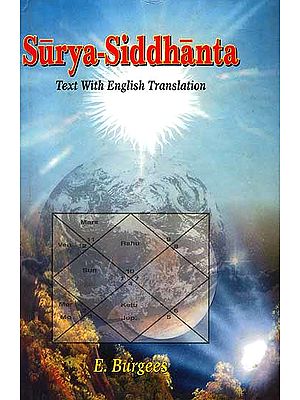
Publisher: Oriental Books Centre, Delhi |
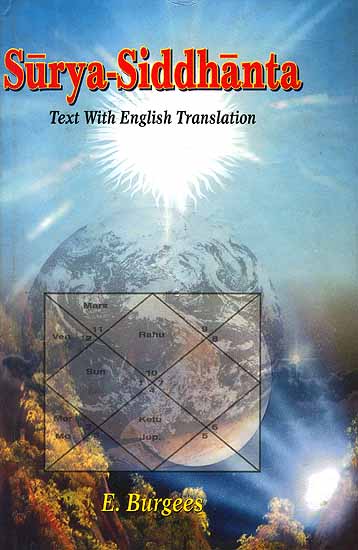
| Author: E. Burgees | |
| Language: English | |
| Pages: 552 | |
| Cover: Hardcover | |
 |
8.6" X 5.6" |
| Edition: 2005 | |
| ISBN: 8183150179 | |
 |
IDJ470 |
| Delivery and Return Policies |
 |
|
 |
Returns and Exchanges accepted within 7 days |
 |
Free Delivery |


Surya Siddhanta of Varaha as given in his Panca Siddhantika are almost the same as those of the Khandakhadyaka, it is clear that the old Surya Siddhanta was made up to date by Varaha by replacing the old constants in it by new ones from Aryabhata I's midnight system. A subsequent redactor of the Surya Siddhanta changed the constants as introduced by following Brahmagupta's teachings in his Brahmasphuta Siddhanta and the Uttara Khandakhadyaka.
Surya Siddhanta is the most important of this class of works and some attempt should yet be made to ascertain its true date. From internal evidence alone Burgess came to the conclusion that the superior limit to its date is 490 A.D. and that the lower limit is 1091 A.D.
Similarity between the Brahmasphuta Siddhanta and the modern Surya Siddhanta and the modern Surya Siddhanta we believe that we have established our view as to the nature of the modern Surya Siddhanta.
Index
The Hindu scientific astronomical works are divided into two classes. Some of these are works of distinguished astronomers like Aryabhata I (499 A.D.), Latadeva (505 A.D.), Varahamihira (550 A.D.), Brahmagupta (628 A.D.), Lalla (748 A.D.), Manjula (932 A.D.), Sripati (1028 A.D.) and Bhaskara II (1150 A.D.), whose works are:
| Works | Authors |
| The Ayabhatiya and another Tantra | Ayabhata I |
| The Romaka and the Paulisa Siddhantas | Latadeva (Expounder) |
| The Panca Siddhantika | Varahamihira |
| The Brahamasphuta Siddhanta and the Khandakhadyaka | Brahmagupta |
| The Sisyadhivrddhida | Lalla |
| The Laghumanasa and the Brhanmanasa | Manjula |
| The Siddhnta Sekhara | Sripati |
| The Siddhanta Siromani | Bhaskara II |
These works and their author are now well known. Of these Latadeva was a direct pupil of Aryabhata I. There is now no doubt as to the times when they lived and composed their works.
Some again of the Hindu astronomical works are alleged as revelations, which means that their authors have hid their names and their times with the definite motive of making their astronomical systems and calculations acceptable to the people of Hindu India, by representing them as direct transmission from their gods. To this class belong the following Siddhantas:-
1. Surya Siddhanta.
2. Paitamha Siddhanta.
3. Vyasa Siddhanta.
4. Vasistha Siddhanta.
5. Atri Siddhanta.
6. Parasara Siddhanta.
7. Kasyapa Siddhanta.
8. Narada Siddhanta.
9. Garga Siddhanta.
10. Marici Siddhanta.
11. Manu Siddhanta.
12. Angira Siddhanta.
13. Lomasa (Romaka ?) Siddhanta.
14. Paulisa Siddhanta.
15. Cyavana Siddhanta.
16. Yavana Siddhanta.
17. Bhrgu Siddhanta.
18. Saunaka Siddhanta.
Their name is eighteen to match the Puranas of which also the name is eighteen, so revelation is eighteen ways stated. The versifier might have easily pushed up the number to twenty which is the number of the authors of the Dharma Sastras. But at the time of Varaha only five of these Siddhantas were known, viz. the Paulisa, Romaka, Vasistha, Saura and the Paitamaha Siddhantas. Even at the time of Bhaskara II, the well-known ones were five, and regarded as ganitas or treatises on astronomy. Some of these eighteen works are known from the quotations made from them by Bhattotpala (966 A.D.) in his commentary on the Brhat Samhita of Varahamihira, while the rest are known in name only. Some of these, again were purely astrological treatises. The Surya Siddhanta is at the top of this class of revelations. It was revealed to Maya an Asura, in all probability an Assyrian or rather a Babylonian. The date is stated to be 2163102 B.C. to which no historical value may be attached. Again the Surya Siddhanta is the most important of this class of works and some attempt should yet be made to ascertain its true date. From internal evidence alone Burgess came to the conclusion that the superior limit to its date is 490 A.D. and that the lower limit is 1091 A.D. as ascertained by Bentley and took the mean date to be 560 A.D. Our view as to the nature of the work is that it is a composite growth dating from about 400 A.D. to the middle of the eighth century of the lower limit may even be the end of the eleventh century as found by Bentley. The date of its commentator Ranganatha is 1603 A.D., when it was made safe from the hands of its interpolators. It is possible to distinguish three distinct stages of its growth:-
(a) The original works as it existed before Varahamihira.
(b) Varaha's redaction with the epicyclic theory in it.
(c) Later additions and alterations.
Evidence of Astronomical constants compared.
All these three stages are discernible firstly from a comparison of the astronomical constant of the modern book with those of Aryabhata I as given or indicated in the Khandakhadyaka of Brahmagupta with those of the Surya Siddhanta of the Panca Siddhantika of Varaha.
| Introduction | vii-xlviii | |
| I. | The Mean Motions of the Planets | 1-73 |
| II. | The True Places of the Planets | 74-147 |
| III. | Direction, Places and Time | 148-195 |
| IV. | Eclipses, and Especially of Lunar Eclipses | 196-221 |
| V. | Papallax in a Solar Eclipse | 222-242 |
| VI. | The Projection of Eclipses | 243-254 |
| VII. | Planetary Conjunctions | 255-274 |
| VIII. | The Asterisms | 275-343 |
| IX. | Heliacal Risings and Settings | 344-353 |
| X. | The Moon's Rising and Setting and of Elevation of Her Cusps | 354-368 |
| XI. | Certain Malignant Aspects of the Sun and Moon | 369-380 |
| XII. | Cosmogony, Geography, Dimensions of the Creation | 381-407 |
| XIII. | The Armillary Sphere and other Instruments | 408-423 |
| XIV. | The Different Modes of Reckoning Time | 424-438 |
| Appendix | 439-525 | |
| Sholka Index | 527-535 | |
| General Index | 537-552 |





Send as free online greeting card



Visual Search
 Upload an Image
