| Specifications |
 |
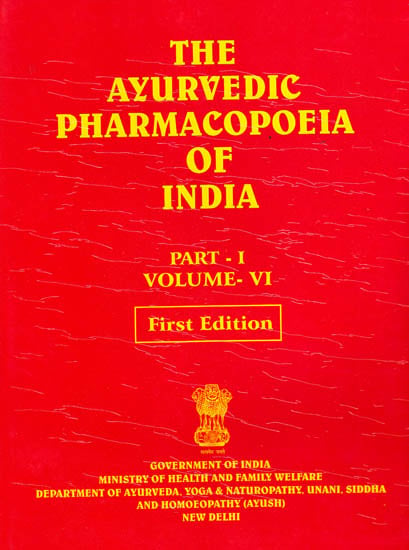
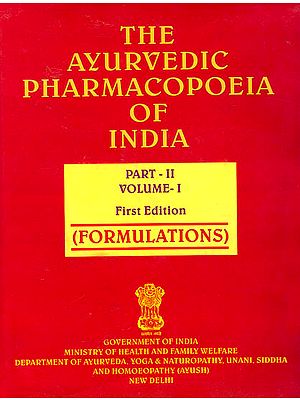
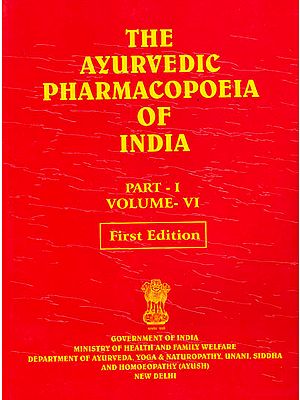
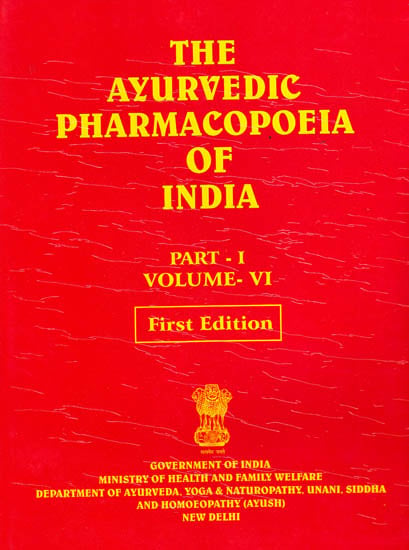
Publisher: Government Of India, Ministry Of Health And Family Welfare, Department Of Ayurveda, Yoga & Naturopathy, Unani, Siddha And Homoeopathy, New Delhi |
| Language: English | |
| Pages: 457 | |
| Cover: Hardcover | |
 |
11.4 Inch X 8.5 Inch |
 |
Weight 1.33 kg |
| Edition: 2009 | |
| ISBN: 8190595210 | |
 |
NAC304 |
| Delivery and Return Policies |
 |
|
 |
Returns and Exchanges accepted within 7 days |
 |
Free Delivery |


Awareness on Quality Standards of Ayurvedic Medicine is increasing with the demand for these products. The growth and acceptability of these medicines depend upon the compliance with the quality standards and in process quality assurance in the manufacture of these medicines. Therefore, it is essential to have scientific standards for identity, purity and strength of these medicines. Government of India appreciated the need for developing Pharmacopoeial Standards of Ayurveda, Siddha & Unani medicines and established the Pharmacopoeial Laboratory of Indian Medicines (PLIM) at Ghaziabad in the year 1970 to undertake pharmacopoeial work on Ayurvedic, Siddha & Unani medicines. The scientific work of PLIM is guided and monitored by the Ayurvedic Pharmacopoeia Committee (APC). The APC comprises of experts in Ayurveda, Pharmacognosy, Phyto-Chemistry, Pharmaceuticals Sciences and Ayurvedic Pharmacy who constantly scrutinize the scientific data generated by PLIM and other Laboratories on Pharmacopoeial work. Quality standardization of natural products is a complex task, therefore, 20 other laboratories of the Council of Scientific & Industrial (CCRAS) and other eminent Laboratories & Universities have been associated with the work of development of the Pharmacopoeial Standards under the APC Scheme of the Department of Ayush. The scientific work of various laboratories is regularly monitored by subject experts of the Ayurvedic Pharmacopoeia Committee.
This Sixth volume of the Ayurvedic Pharmacopoeia of India containing 101 monographs of single drugs is a result of hard work of experts of Pharmacopoeia Committee, scientists working in PLIM, CCRAS and other laboratories associated with the APC Scheme. I place on record my appreciation for the dedication and hard work put by the officers of the dedication and hard work put by the officers of the Department of Ayush, PLIM, CCRAS and experts associated with the APC in the publication of this Volume. I hope that the Drug Testing Laboratories, in-house Quality Control Labs of Manufacturing units, teaching and R&D institutions will be highly benefited with this publication and their suggestions and feedback will be welcome for updation of APC Volumes.
The first and second part of the Ayurvedic Formulary of India comprising of 444 and 191 formulations respectively cover more than 351 single drugs of plant origin. This is part of nearly 500 priority single drugs of plant origin to come with in the ambit of the Ayurvedic Pharmacopoeia of India. The Ayurvedic Pharmacopoeia of India, Part-I, Vol-I, Vol-II, Vol-III, Vol IV and V comprises 80, 78, 100, 68 and 72 monographs of Ayurvedic single drugs of plant origin which go into one or more formulations included in the Ayurvedic Formulary of India, Part-I and Part-II. As a continuing activity monographs on 96 single drugs of plant origin and four monographs each on Gupta (Jaggery), Goghrta (Clarified Cow’s Butter), Jala (Potable water), Madhu (Honey) and Sarkara (Sugar) used as Vehicle or adjuvant, making compilation of Vol VI of the Ayurvedic Pharmacopoeia of India Part-I comprising of these 101 monographs. In compiling the monograph, each monograph bears the title of the drug in Sanskrit as given in Ayurvedic Formulary of India. This is followed by definition of the drug giving botanical identity by using scientific binomial nomenclature with authority and very brief information about its source, occurrence, distribution and precautions to the taken during collection, if any. List of synonyms in Sanskrit and also in other Indian regional languages. The monograph further records macroscopic and microscopic description of the drug highlighting diagnostic features for identification and authentication even if the drug is in powdered state. The monograph further gives under identity, Purity and Strength, certain physico chemical parameters such as limits of foreign matter, moisture content, total ash, acid insoluble ash, alcohol soluble extractive, water soluble extractive, volatile content (if any) followed by thin layer chromatographic fingerprint profile. Wherever feasible, an Assay of active/maker chemical constituent or a group of chemical constituents such as total alkaloids or volatile oil etc have been given. There is always range of variations in data on chemical constituents and certain physico chemical parameters due to geographical, climatic and ontogenetic variability. Therefore, variations in results of such data pose difficulty in fixing narrow range. The data has been given on the basis of average results of 3 samples from different laboratories. Under the constituents major chemical constituents as reported in the literature have been given.
Under each monograph, classical attributes of each drug according to the doctrine of Rasa, Guna, Virya, Vipaka and Karma have been kept intact. These are considered a reasonable basis and convenient reference point for a clinical classification. Such parameters are not possible to measures by modern scientific methods thus not mandatory.
The legal notices and general notices have been provided for pharmaceutical and regulatory purposes. The Appendices include details of the apparatus, reagents, chemicals, solution tests, methods of preparation of samples for microscopic or chromatographic examination.
The committee hopes that the publication of Ayurvedic Pharmacopoeia of India, Part-I Vol-VI containing 101 monographs would add to the requirements under the Drugs and Cosmetic Act. The regular monitoring of the manufactured and marketed Ayurvedic drugs, on the basis of the standards prescribed here in would bear evidences of the usefulness of these volumes and help ensure their quality and status revision for the future.
The committee urges the Government of India to recommend the adoption of these monographs for the purposes of identity, purity and strength of drugs for use in their Government, Semi-Government and Government aided institutions and voluntary public organizations. The Ayurvedic Pharmacopoeia of India, Part-I, Vol. VI, 2008 would be added to Rule 168 of the Drugs and Cosmetics Act and be notified by Government as standards to be complied with the manufacturers for sale or distribution of Ayurvedic drugs Ayurvedic Pharmacopoeia of India, Part-I, Vol. I, II, III, IV and V are already included in the First Schedule of Drugs & Cosmetics act 1940.
| Legal Notices | xiii | |
| General Notices | xiv | |
| Preface | xix | |
| Acknowledgement | xxi | |
| Introduction | xxii | |
| Contributing Laboratories & Institutions | xxx | |
| Monographs | ||
| 1. Adari (Lf.) | Acacia pennata (L.) Willd. | 1 |
| 2. Amragandhi-guggulu (L.f.) | Balsamodendron caudate Mauch | 3 |
| 3. Aranya-surana (Tuber) | Synantherias syeatica Schoot Gen.Aocja | 5 |
| 4. Ararota (Rz.) | Maranta arundinacea L. | 7 |
| 5. Asthirsnkhala (Aerial Part) | Cissus quadrangularis L. | 9 |
| 6. Bhutakesi (Rr.) | Selinum vaginatum C.B. Clarke | 12 |
| 7. Bhutakesi (Rz.) | Selinum vaginatum C.B. Clarke | 14 |
| 8. Bijapatra (Wh.Pl.) | Adiantum cappillus-veneris L. | 16 |
| 9. Bimbi (Lf.) | Coccinia grandis (L.) Voigt | 19 |
| 10. Bimbi (St.) | Coccinia grandis (L.) Voigt | 21 |
| 11. Brhat Dugdhika (Wh.Pl.) | Euphorbia hirta L. | 23 |
| 12. Brhati (Wh.Pl.) | Solanum anguivi Lam. | 26 |
| 13. Canaka (Wh.Pl.) | Cicer arietinum L. | 29 |
| 14. Daruharidra (Fr.) | Berberis aristata DC. | 32 |
| 15. Dhava (Fr.) | Anogeissus latifolia Wall. | 34 |
| 16. | Anogeissus latifolia Wall. | 36 |
| 17. Dvipantara Damanaka (Wh.Pl.) | Artemisia absinthium L. | 38 |
| 18. Dvipantara Satavari (Rt.) | Asparagus officinalis L. | 41 |
| 19. Elavalukam (Rt.) | Prunus avium L. | 43 |
| 20. Elavalukam (St. Bk.) | Prunus avium L. | 45 |
| 21. Erandakarkati (Fr) | Carica papaya L. | 47 |
| 22. Erandakarkati (Rt.) | Carica papaya L. | 49 |
| 23. Gandhasipha (Wh.Pl.) | Pavonia odorata Willd. | 51 |
| 24. Grismachatraka (Wh.Pl.) | Mollugo cerviana Seringe. | 54 |
| 25. Goksura (Wh. Pl.) | Tribulus terrestris L. | 56 |
| 26. Granthimula (Rz.) | Alpinia calcarata Rosc. | 59 |
| 27. Guladaudi (Lf.) | Chrysanthemum indicum L. | 61 |
| 28. Haritamanjari (Wh. Pl.) | Acalypha indica L. | 63 |
| 29. Hastisundi (Wh.Pl.) | Heliotropium indicum L. | 66 |
| 30. Indivara (Rz.) | Monochoria voginalis Prest. | 68 |
| 31. Jalakumbhi (Wh.Pl.) | Pistia stratiotes L. | 70 |
| 32. Jivanti (Rt.) | Leptadenia reticulate W. & A. | 73 |
| 33. Kantakigulma (Aerial Part) | Lycium barbarum L. | 75 |
| 34. Karaphsa (Rt.) | Apium graveolens L. | 78 |
| 35. Katugulma (Wh.Pl.) | Toddalia asiatica (L.) Lam. | 80 |
| 36. Kesaraja (Wh. Pl.) | Wedelia calendulacea Less non Rich. | 83 |
| 37. Ketaki (Stilt Rt.) | Pandanus odoratissimus L.f. | 86 |
| 38. Kitamari (Lf.) | Aristolochia bracteata Retz | 88 |
| 39. Kumarivetra (Rz.) | Calamus thwaitesii Becc. | 90 |
| 40. Kusumbha (Fr.) | Carthamus tinctorius L. | 92 |
| 41. Kusumbha (Lf.) | Carthamus tinctorius L. | 94 |
| 42. Kusumbha (Fl.) | Carthamus tinctorius L. | 96 |
| 43. Laghu Haritamanjari (Rt.) | Acalypha fruticosa Forsk. | 99 |
| 44. Laghupatra-varsabhu (Wh.Pl.) | Trianthema decandra L. | 101 |
| 45. Lohitaniryasa (Exd.) | Dracaena cinnabari Balf. f. | 104 |
| 46. Madhavi (Fl) | Hiptage benghalensis L. | 106 |
| 47. Matsyapatrika (Wh.Pl.) | Merremia tridentate (L.) Hall.f. | 108 |
| 48. Meda (Rz.) | Polygonatum cirrhifolium Royle. | 111 |
| 49. Niadihingu (Exd.) | Gardenia gummifera L.f. | 113 |
| 50. Nahi (Wh.PI.) | Enicostemma axillare (Lam.) A. Raynal. | 115 |
| 51. Nikocake (Kernel) | Pinus gerardiana Wall | 118 |
| 52. Panasa (Rt.Bk.) | Artocarpus heterophyllus Lamk. | 120 |
| 53. Papatah (Rt.) | Pavetta indica L. | 122 |
| 54. Parnayavani (Lf.) | Coleus amboinicus Lour. | 124 |
| 55. Patra snuhi (Latex) | Euphorbia nivulia Buch-Ham. | 127 |
| 56. Pinda Tagara (Rz.) | Asarum europaeum L. | 129 |
| 57. Pita-kancanara (Fl.) | Bauhinia racemosa Lamk. | 131 |
| 58. Rakta Citraka (Rt.) | Plumbago indica L. | 133 |
| 59. Rohitaka (St.Bk.) | Tecomella undulate (Sm.) Seem. | 135 |
| 60. Sala (Ht. Wd.) | Shorea robusta Gaertn. | 137 |
| 61. Salaparni (Wh. Pl.) | Desmodium gangeticum DC. | 139 |
| 62. Sami (Lf.) | Prosopis cineraria Druce | 142 |
| 63. Saurabhanimba (Lf.) | Murraya koenigii (L.) Spreng | 145 |
| 64. Sitivaraka (Sd.) | Celosia argentea L. | 148 |
| 65. Siva-nili (Rt. & St.) | Indigofera aspalathoides Vahl ex DC. | 150 |
| 66. Slesmataka (Fr.) | Cordia dichotoma Forst. F. | 152 |
| 67. Slesmataka (St.Bk.) | Cordia dichotoma Forst. F. | 154 |
| 68. Slipadarikanda (Tuber) | Typhonium trilobatum Schott | 156 |
| 69. Sphitakitari (Rz.) | Dryopteris filix-mas (L.) Schott | 158 |
| 70. Sprkka (Wh. Pl.) | Anisomeles malabarica (L.) R.Br. ex Sims | 160 |
| 71. Sruvavrksa (Fr.) | Flacourtia indica (Burm.f.) Merr. | 163 |
| 72. Sthulaila (Fr.) | Amomum subulatum Roxb. | 165 |
| 73. Sukanasa (Rz.) | Corallocarpus epigaeus Benth.ex Hook.f. | 167 |
| 74. Sveta Vetasa (Lf.) | Salix alba L. | 169 |
| 75. Takkola (Fr.) | Illicium verum Hook. f. | 171 |
| 76. Tinduka (Fr.) | Diospyros peregrine Gurke | 173 |
| 77. Trayamana (Rz.) | Gentiana kurroo Royle | 175 |
| 178. Tripaksi (Wh.Pl.) | Coldenia procumbens L. | 177 |
| 179. Tuvaraka (Sd.) | Hydnocarpus pentandra (Buch-Ham.) Oken | 180 |
| 180. Osandi (Wh.Pl.) | Glinus lotoides L. | 182 |
| 81. Vajranna (Lf. Base) | Pennisetum typhoides (Burm.f.) stapf & C.E. Hubb. | 185 |
| 82. Valuka-Saka (Lf.) | Gisekia pharnaceoides L. | 187 |
| 83. Vanya-asvagola (Lf.) | Plantago lanceolata L. | 189 |
| 84. Vetra (Rz.) | Calamus rotang L. | 191 |
| 85. V isanika (Wh.Pl.) | Pergularia daemia (Forsk) Chiov. | 193 |
| 86. Vrantamlaphala (Fr. Rind) | Garcinia pedunculata Roxb. | 196 |
| 87. Vrscikakanda (Rz.) | Doronicum hooker C.B. Clarke | 198 |
| 88. Darusita Taila (Cinnamomum Oil) | Cinnamonum zeylanicum Blume | 200 |
| 89. Gandhapura Patra Taila | Gaultheria fragrantissima Wall. | 202 |
| 90. Karpura (Natural Camphor) | Cinnamomum camphora (L.) Nees & Eberm. And Ocimum kilimandscharicum Guerke | 204 |
| 91. Lavanga Taila (Clove Oil) | Syzygium aromaticum Merril & Perry | 206 |
| 92. Peppermint-Satva (Menthol) | Mentha sps. | 208 |
| 93. Sarsapa Tail (Mustard Oil) | Brassica campestris L. | 210 |
| 94. Tailaparna Taila (Eucalyptus Oil) | Eucalyptus globulus Labill | 212 |
| 95. Tila Taila (Sesamum Oil) | Sesamum indicum L. | 214 |
| 96. Yavani Satva (Thymol) | Thymus vulgaris L. and Trachyspermum amni (L.) Sprague | 216 |
| 97. Goghrta (Clarified Cow’s Butter | 218 | |
| 98. Guda (Jaggery) | Saccharum officinarum L. | 220 |
| 99. Jala (Potable water) | 222 | |
| 100. Madhu (Honey) | Apis sps | 224 |
| 101. Sarkara (Sugar) | 226 | |
| Appendix-1 | 1.1 Apparatus for Tests and Assays | 230 |
| 1.1.1. Nessler Cylinder | 230 | |
| 1.1.2. Sieves | 230 | |
| 1.1.3. Thermometers | 231 | |
| 1.1.4. Ultra-Violet Lamp (For general purposes & for chromatography work) | 231 | |
| 1.1.5. Volumetric Glass Ware | 231 | |
| 1.1.6. Weights and Balances | 231 | |
| 1.1.7. Muslin Cloth | 232 | |
| Appendix-2 | 2.1 Tests and Determinations | 233 |
| 2.1.1. Microscopic identification | 233 | |
| 2.1.2. Microscopical Methods of Examining Crude Vegetable Drugs | 236 | |
| 2.1.3. Types of Stomata | 239 | |
| 2.1.4. Determination of Stomatal Index | 240 | |
| 2.1.5. Determination of Palisade Ratio | 240 | |
| 2.1.6. Determination of Vein-Islet Number | 241 | |
| 2.1.7. Determination of Stomatal Number | 242 | |
| 2.2 Determination of Quantitative Data | 242 | |
| 2.2.1 Net Content | 242 | |
| 2.2.2. Foreign Matter | 242 | |
| 2.2.3. Determination of Acid Toatal Ash | 242 | |
| 2.2.4. Determination of Acid Insoluble Ash | 242 | |
| 2.2.5. Determination of Water Soluble Ash | 243 | |
| 2.2.6. Determination of Sulphated Ash | 243 | |
| 2.2.7. Determination of Alcohol Soluble Extractive | 243 | |
| 2.2.8. Determination of Water Soluble Extractive | 243 | |
| 2.2.9. Determination of | 243 | |
| 2.2.10. Determination of Moisture Content (Loss on Drying) | 243 | |
| 2.2.11. Determination of Water Insoluble Matter | 244 | |
| 2.2.12. Determination of Volatile Oil in Drugs | 244 | |
| 2.2.13. Special Processes Used in Alkaloidal Assays | 245 | |
| 2.2.13a. Continuous Extraction of Drug | 245 | |
| 2.2.13b. Tests for Complete Extraction of Alkaloids | 245 | |
| 2.2.14. Thin – Layer Chromatography (TLC) | 246 | |
| 2.2.15. Starch Estimation (Mont Gomery, 1957) [Spectrophotometric method] | 248 | |
| 2.2.16. Sugar Estimation (Mont Gomery, 1957) [Spectrophotometric method] | 248 | |
| 2.2.17. Fatty Oil Estimation | 249 | |
| 2.2.18. Test for Argemone Oil (Mustard Oil) | 249 | |
| 2.2.19. Test for the Presence of Cottonseed Oil (Halphen Test) | 249 | |
| 2.2.20. Test for Clove Oil – Alkali – Soluble Matter | 249 | |
| 2.2.21. Test for Eucaluptus Oil | 249 | |
| 2.2.22. Determination of Acidity | 250 | |
| 2.2.23. Protein Estimation (Lowry et al., 1951) | 251 | |
| 2.2.24. Method for Alkaloid Estimation | 251 | |
| 2.2.25. Determination of Esters | 251 | |
| 2.3. Limit Tests | ||
| 2.3.1. Limit Test for Arsenic | 252 | |
| 2.3.2. Limit Test for Chlorides | 252 | |
| 2.3.3. Limit Test for Heavy Metals | 256 | |
| 2.3.4. Limit Test for Iron | 256 | |
| 2.3.5. Limit Test for Lead | 259 | |
| 2.3.6. Limit Test for Sulphates | 261 | |
| 2.3.7. Heavy Metals by Atomic Absorption Spectorphotometry | 261 | |
| 2.3.8. Determination of Lead, Cadmium, Arsenic, Mercury and Copper | 263 | |
| 2.3.9. Determination of Calcium Oxide | 266 | |
| Microbial Limit Tests | ||
| 2.4.1. Total Aerobic Microbial Count | 275 | |
| 2.4.2. Tests for Specified Micro-Organisms | 277 | |
| 2.5. Pesticide Residue | 280 | |
| 2.5.1. Qualitative and Quantitative Analysis of Pesticide Residues | 282 | |
| 2.5.2. Test for Pesticides | 283 | |
| 2.5.3. Quantitative Analysis | 284 | |
| 2.6. Gas Chromatography | 286 | |
| 2.7. Test of Aflatoxins | 288 | |
| Appendix-3 | 3.1. Physical Test and Determinations | 290 |
| 3.1.1 Refractive Index | 290 | |
| 3.1.2. Weight per Millimeter and Specific Gravity | 290 | |
| 3.1.3. Determination of pH Values | 291 | |
| 3.2. Determination of Melting Range and Congealing Range | 291 | |
| 3.2.1. Determination of Melting Range | 291 | |
| 3.2.2. Determination of Congealing Range | 293 | |
| 3.2.3. Determination of Boiling Range | 294 | |
| 3.3. Determination of Optical Rotation and Specific Optical Rotation | 296 | |
| 3.4. Determination of Viscosity | 297 | |
| 3.5. Determination of Total Solids | 298 | |
| 3.6.Solubility in Water | 298 | |
| 3.7. Determination of Saponification Value | 298 | |
| 3.8. Determination of Iodine Value | 299 | |
| 3.9. Determination of Acid Value | 300 | |
| 3.10. Determination of Peroxide Value | 300 | |
| 3.11. Determination of Unsaponifiable Matter | 301 | |
| 3.12. Determination of Mineral Oil (Holde’s Test) | 301 | |
| 3.13. Rancidity Test (Kreis number) | 301 | |
| 3.14. Determination of Reichert Meissl and Polenske Value | 302 | |
| 3.15. Determination of Alcohol Content | 303 | |
| Appendix-4 | 4.1 Reagents and Solutions | 307 |
| Appendix-5 | 5.1. Chemical Tests and Assays | 336 |
| 5.1.1. Estimation of Total Phenolic | 336 | |
| 5.1.2. Estimation of Total Tannins | 336 | |
| 5.1.3. Estimation of Sugars | 336 | |
| 5.1.3.1. Reducing sugars | 337 | |
| 5.1.3.2. Total sugars | 337 | |
| 5.1.3.3. Non-reducing sugars | 337 | |
| 5.1.4. Feihe’s Test | 338 | |
| 5.1.5. Aniline Chloride Test | 338 | |
| 5.1.6. Determination of Sulphur Dioxide | 338 | |
| 5.1.7. Determination of Total Reducing Sugars, Sucrose and Fructose-Glucose Ration | 340 | |
| 5.2 Estimation of Curcumin by TLC Densitometer | 341 | |
| 5.2.1. Determination of Aluminium | 342 | |
| 5.2.2. Determination of Borax | 343 | |
| 5.2.3. Determination of Calcium | 343 | |
| 5.2.4. Determination of Copper | 343 | |
| 5.2.5. Determination of Iron | 344 | |
| 5.2.6. Determination of Magnesium | 345 | |
| 5.2.7. Determination of Mercury | 345 | |
| 5.2.8. Determination of Silica | 345 | |
| 5.2.9. Estimation of Sodium and Potassium by Flame Photometer | 345 | |
| 5.2.10. Determination of Sodium Chloride | 346 | |
| 5.2.11. Determination of Sulphur | 346 | |
| 5.2.12. Qualitative Reactions of Some Radicals | 346 | |
| Appendix-6 | 6.1. Weights and Measures | 349 |
| 6.1.1. Metric Equivalents of Classical Weights and Measures | 349 | |
| 6.2. Metric system | 350 | |
| Appendix-7 | 7.1. Classical Ayurvedic References | 351 |
| Index | 388 | |
| Definitions | 415 | |
| Monographs published in Volume-I | 416 | |
| Monographs published in Volume-II | 418 | |
| Monographs published in Volume-III | 420 | |
| Monographs published in Volume-IV | 423 | |
| Monographs published in Volume-V | 425 |




Send as free online greeting card



Visual Search
 Upload an Image