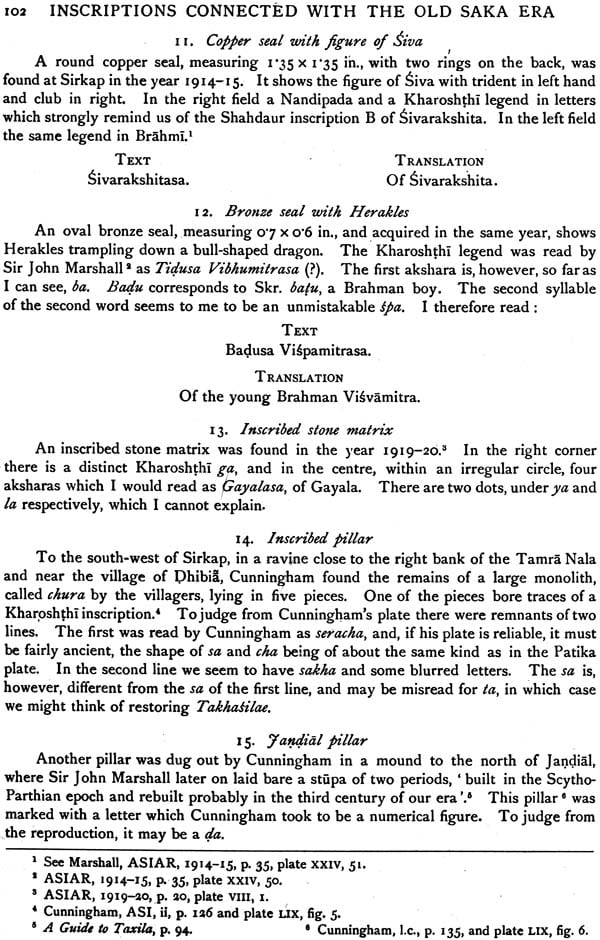
| Specifications |
 |
Publisher: ARCHAEOLOGICAL SURVEY OF INDIA |
| Author Sten Konow | |
| Language: English | |
| Pages: 357 (With 1 Map and 36 Plates) | |
| Cover: Hardcover | |
 |
14.5 inch x 10.0 inc |
 |
Weight 1.50 kg |
| Edition: 1991 | |
 |
NAJ638 |
| Delivery and Return Policies |
 |
|
 |
Returns and Exchanges accepted within 7 days |
 |
Free Delivery |


Preface
More than ten
years ago arrangements were concluded for the preparation of a volume of Kharoshthi and Brahmi
inscriptions, to be edited jointly by Professors Luders
and Rapson and to be issued as vol. ii of the Corpus inscriptionum Indicarum.
In 1922 Professor
Rapson intimated that his other engagements precluded
him from undertaking the work, and, at the suggestion of the Government of
India, the Secretary of State for India in Council decided to offer the vacant
post to me, and this was done in a letter of the 17th November 1922.
Having already
devoted much time to the study of Kharoshthi and Kharoshthi inscriptions I gladly accepted the offer, though
I much regretted that Professor Rapson, with his
unrivalled knowledge of Kharoshthi, had not been able
to undertake the task.
During the six
years which have passed since then I have given most of my time to the work.
Through the
courtesy of the Indian Government I was able to visit the chief Indian Museums
and examine the originals of most Kharoshthi inscriptions
in the first months of 1925, and through the kind services of Sir John Marshall
I have been provided with estampages and photographs
of all the inscriptions preserved in India. The authorities of the British
Museum and the Royal Asiatic Society have sent me photographs of the
inscriptions in their possession, and the India Office has been good enough to
prepare for my use an excellent plaster-of-Paris cast of the Mathura Lion
Capital. Finally, the French authorities have, at the request of the Foreign
Office, graciously placed at my disposal reproductions of the Kharoshthi records preserved in the French capital. For all
the assistance given me in this way I beg to offer my sincere thanks.
My friends
Professors Karlgren, Luders,
and Thomas have laid me under heavy obligation in connexion with my work.
Professor Karlgren has gone through the proofs of the
introduction and saved me from several mistakes. Professor Thomas has kindly
read the proofs of the whole volume, and both he and Professor Luders have on several occasions discussed many difficult
points with me and helped me in many ways. I have tried to acknowledge the
assistance I have received in this way, but I am afraid that I
have done so unsatisfactorily, and in this place I should like to give
expression to the cordial gratitude which I feel towards them.
Finally, I
wish to add that it is largely due to the Oxford University Press if the outer
appearance of the book will be found satisfactory. To people who have often had
to fight some printing-office in order to produce fairly acceptable work it is
a rare experience to co-operate with the Clarendon Press and to feel that there
is no fight, but only a competition in order to make the results as excellent
as it is possible at the present day.
Introduction
Kharoshthi
cannot, like Brahmi, be characterized as the national
alphabet of India. It has, it is true, been developed on Indian soil and for
noting down the sounds of an Indian language,' but its use was restricted to a
comparatively limited territory, and even there we have occasional indications
of Brahmi having been employed, e. g. in ancient seal
legends from Taxila.
Buhler has
shown that the Kharoshthi characters are derived from
Aramaic, which (was in common use for official purposes all over the Achaemenian empire during the) period when it comprised
north-western India. Some features, such as the vowel system and the compound
consonants, point to the conclusion that the alphabet was elaborated with the
help of Brahmi, which must accordingly have been in
existence for some time previously.
From the
purely Indian point of view there was not, therefore, any necessity for framing
a new script. And Buhler is evidently right in assuming that Kharoshthi is 'the result of the intercourse between the
offices of the Satraps and of the native authorities, the Indian chiefs and the
heads of towns and villages, whom, as the accounts of the state of the Panjab at the time of Alexander's invasion show, the Persians
left in possession in consideration of the payment of their tribute. The Hindus
probably used at first the pure Aramaic characters, just as in much later times
they adopted the Arabic writing for a number of their dialects, and they
introduced in the course of time the modifications observable in the Kharoshthi alphabet.
This
development may have taken some time. It was an accomplished fact in the I
middle of the third century B.C.,
when the alphabet was used in the Mansehra and Shahbazgarhi versions of Asoka's edicts, though Aramaic was
then still in use, as shown by the Aramaic inscription found at Taxila, in which Professor Andreas has recognized Asoka's
usual designation Priyadarsin: The alphabet then
remained in use for more than half a millennium, the last known Kharoshthi inscriptions dating from the fourth or fifth
century A. D.
Buhler has
pointed out that Kharoshthi is evidently a clerk's
and not a Pandit's k alphabet.
Outside of India we find it used also in books, in the Dutreuil
de Rhins manuscript containing a version of the Dhammapada in a north-western Prakrit,
which has been found near Khotan. It is possible that
the same may sometimes
have been the case in India, and it is even possible that the Dutreuil de Rhins manuscript was
written in India. The only old manuscript actually found in India within the
territory and the period covered by Kharoshthi
inscriptions is, however, written in Brahmi.
The area
within which we can prove Kharoshthi to have been
regularly used belongs to the north-west. The easternmost limit is, in the Panjab, at Manikiala. There are'
two inscriptions from Kangra, where Kharoshthi is used in addition to Brahmi,
and there is another record from Kamal, which shows that the alphabet was known
further to the east, and foreign conquerors from the north-west used it in a
well-known inscription in Mathura on the Jamna,
where Brahmi was the common alphabet, also in
inscriptions and on coins. We even possess a Kharoshthi
record from Patna.
But the plaque
on which it is written has evidently been left there by a person who came from
the north-west. We do not know exactly how far the use of Kharoshthi
extended towards the west. Coins with Kharoshthi
legends have been found in Seistan and Kandahar, but
the western most Kharoshthi inscriptions which have
been found are from Khawat in Afghanistan and, side
by side with Brahmi records, from the Thal valley in Baluchistan. And even here we have every
reason for assuming that the alphabet was brought and used by immigrants from
the east. For it is little suited for the requirements of Iranian languages,
and we have nothing to show that the dialect in which most Kharoshthi
records are written was ever spoken as a vernacular much further east than Jalalabad.
The
northernmost Kharoshthi records come from Tirath in Swat and Khalatse in Ladakh, and in the south we have some fragments from Mohenjo Daro in the Larkana district and Kharoshthi
legends on the coins of some of the oldest of the Western Kshatrapas.
But such stray instances do not prove anything more for the proper Kharoshthi area than the Kharoshthi
word lipikarena in the Siddapur
edicts of Asoka. The Kharoshthi area proper may be
defined as extending from about 69° to 73° 30' E. and from the Hindu Kush to
about 33° N., and there can be little doubt that its place of origin was Gandhara, perhaps more especially Taxila.
Professor
Sylvain Levi has given a different account of the origin of Kharoshthi.
From a notice in Chinese Buddhist literature, according to which the correct
form of the name Shu-le, i.
e. Kashgar, is K'ia-lu-shu-ta(n)-le, which, according to
M. Levi, corresponds to Sanskrit Kharoshtra, he draws the conclusion that the
correct name of the alphabet was Kharoshtri, and that this name means' the
script of Kharoshtra i. e. Kashgar.
Messrs. O. Franke and R. Pischel protested
against this explanation," and M. Levi S modified
his theory and rIl9.lntained that Kharoshtri was the script of Kharoshtra, and this again an old Indian
designation of the country between India and China. Franke
objected that we have no such Sanskrit word as Kharoshtra, that the Chinese Kia-lu- shu-tan-lu can
hardly be a rendering of such a form, and that the Indian name of the alphabet
is given as Kharoshthi, Kharotthi in
Indian sources.
So far as I can
see, M. Levi's theory is hardly reconcilable with what we know about the
history of the alphabet.
I t is true
that numerous Kharoshthi documents have been found in
Chinese Turkestan, notably in the eastern oases to the south of the desert, and
that the only known Kharoshthi manuscript comes from
the Khotan country. The alphabet is, however,
everywhere used for writing an Indian language, and we should a priori be inclined to
think that it was brought to Turkestan by Indian immigrants. Moreover, the manuscript
and the documents belong to a comparatively late date, none of them being
apparently older than the second century A. D.
In India, on
the other hand, the use of Kharoshthi can be traced
back to the third century B. C.
Moreover, Buhler seems to me to have' proved definitely that it has been
evolved from Aramaic to suit the exigencies of an Indian language; and we know
that Aramaic was used in the Achaemenian offices and
also that it was used in north-western India. At the time when' Kharoshthi came into existence there does not seem to have
been any Indian settlement in Turkestan, which was then peopled by various
nomadic tribes, who do not seem to have been in possession of any developed
civilization.
It therefore
seems to me that we must accept Buhler's view about the origin of Kharoshthi, I also think that he was right in assuming that
the name was in India considered to mean' the script invented by Kharoshtha ', though it is quite possible that it is due to
a popular etymology of an Aramaic word meaning' writing', which -sounded like kharottha and was Sanskritized
as kharoshtha, ass-lip.
I am not,
however, in this place concerned with the origin and the older history of Kharoshthi, The inscriptions published in this volume do
not belong to the period when the script first began to 'be
used, and none of them can be brought into connexion
with the Achaemenians or with, the Mauryans, who succeeded them as rulers over north- western
India.
Most of them
belong to the period
when new conquerors had made themselves masters of the country, after the
downfall of the Mauryan empire,
and the oldest of them can be directly connected with these foreign invaders.
Three such
peoples are often mentioned together in Indian sources: the Yavanas,
the Sakas, and the Pahlavas,
and they are all represented in Kharoshthi
inscriptions.
The Yavanas or Yonas, i. e. the
Greeks, had already made their appearance on Indian soil before the Mauryan dynasty came into being. Lt was, however, only at a
somewhat later date that they began to penetrate the north-western provinces in
earnest. In the first half of the second century B.C. Greek
rulers crossed the Hindukush and made themselves
masters of the Kabul country and north-western India: the houses of Euthydemus and Eucratides. And
Greek princes held their own in these districts down to the first century B.
C.
Demetrius, who
seems to have made himself master of parts of India about 175 B.C.,
began to use Kharoshthi in
his coin legends, and this practice was continued down to the last Greek ruler
In the Kabul valley, Hermaeus, In the first century A.D.
Most of these
rulers are only known from their coins, and our information about them is
rather scanty. We can, however, see that their conquest led to the result that
Greek notions came to exercise a certain influence in the Indian borderland,
notably in the framing of the calendar and in the development of Buddhist art.
Contents
|
|
LIST OF PLATES |
XI |
|
|
ABBREVIATIONS |
XII |
|
|
HISTORICAL INTRODUCTION |
XIII |
|
|
THE ERAS USED IN KHAROSHTHI
INSCRIPTIONS |
LXXXII |
|
|
GRAMMATICAL SKETCH |
XCV |
|
|
CONTENTS OF KHAROSHTHI INSCRIPTIONS |
CXVI |
|
|
VARYING SHAPES OF THE LETTERS |
CXIX |
|
A. |
INSCRIPTIONS OF GREEK CHIEFS AND UNCLASSED
NORTH·WESTERN RECORDS. |
|
|
I. |
Swat relic vase inscription of the Meridarkh Theodoros |
1 |
|
II. |
Taxila
copper-plate inscription of a Meridarkh |
4 |
|
III. |
Bajaur
seal inscription of Theodamas |
6 |
|
IV. |
Paris cornelian inscription |
7 |
|
V. |
Tirath
rock inscription |
8 |
|
VI. |
Swat rock inscription |
9 |
|
VII. |
Saddo
rock inscription |
9 |
|
B. |
INSCRIPTIONS CONNECTED WITH THE OLD
SAKA ERA. |
|
|
VIII. |
Maira
inscription of the year 58 |
11 |
|
IX. |
Shahdaur
inscription of Damijada |
13 |
|
X. |
Shahdaur
inscription of Sivarakshita |
16 |
|
XI. |
Mansehra
inscription of the year 68 |
18 |
|
XII. |
F atehjang
stone inscription of the year 68 |
21 |
|
XIII. |
Taxila
copper-plate inscription of Patika, the year 78 |
23 |
|
XIV. |
Muchai
inscription of the year 81 |
29 |
|
XV. |
The Mathura Lion Capital |
30 |
|
XVI. |
Mathura elephant inscription |
49 |
|
XVII. |
Bimaran
vase inscription |
50 |
|
XVIII. |
Kala Sang inscription of the year 100
(?) |
52 |
|
XIX. |
Mount Banj inscription
of the year 102 |
55 |
|
XX. |
The so-called Takht-i-Bahi inscription of the year 103 |
57 |
|
XXI-XXII. |
Other Takht-i-Bahi inscriptions |
63 |
|
XXIII. |
Paja
inscription of the year 111 |
63 |
|
XXIV. |
Kaldarra
inscription of the year 113 |
65 |
|
XXV. |
Marguz
inscription of the year 117 (?) |
66 |
|
XXVI. |
Panjtar
inscription of the year 122 |
67 |
|
XXVII. |
Taxila
silver scroll inscription of the year 136 |
70 |
|
XXVIII. |
Peshawar Museum inscription of the
year 168 |
77 |
|
XXIX. |
Khalatse
inscription of the year 187 (?) |
79 |
|
XXX. |
Taxila
silver vase inscription of the year 191 |
81 |
|
XXXI. |
Taxila
gold-plate inscription |
83 |
|
XXXII. |
Taxila
vase inscription |
87 |
|
XXXIII. |
Taxila
copper ladle 'inscription |
87 |
|
XXXIV |
Bedadi
copper ladle inscription |
88 |
|
XXXV. |
Dharmarajika
inscriptions |
89 |
|
XXXVI. |
Jaulia
inscriptions |
92 |
|
XXXVII. |
Minor Taxila
inscriptions. |
97-103 |
|
XXXVVIII. |
Seal inscription of Sivasena |
103 |
|
XXXIX. |
Dewai
inscription of the year 200 |
104 |
|
XL. |
Loriyan
Tangai pedestal inscription of the year 318 |
106 |
|
XLI. |
Loriyan
Tangai inscription, no. 4860 |
107 |
|
XLII. |
Loriyan
Tangai inscription, no. 4871 |
108 |
|
XLIII. |
Loriyan
Tangai inscription, no. 4995 |
109 |
|
XLIV. |
Loriyan
Tangai inscription, no. 5095 |
110 |
|
XLV. |
jamalgarhi
inscription of the year 359 |
110 |
|
XLVI. |
Jamalgarhi
pedestal inscription |
113 |
|
XLVII. |
Jamalgarhi
image halo inscription |
114 |
|
XLVIII. |
Jamalgarhi
pilaster base inscription |
114 |
|
XLIX. |
Lahore museum halo inscription |
115 |
|
L. |
Lahore pedestal inscription |
115 |
|
LI. |
Jamalgarhi
lamp inscription |
116 |
|
LII. |
Jamalgarhi
pavement stone inscription |
116 |
|
LIII. |
Hashtnagar
pedestal inscription of the year 384 |
117 |
|
LIV. |
Palata
Dheri
pedestal inscription |
120 |
|
LV. |
Palata
Dheri jars inscriptions. |
120 |
|
LVI. |
Sahr-i-Bahlol potsherds |
122 |
|
LVII. |
Ghaz
Dheri
pedestal inscription |
123 |
|
LVIII. |
Shahr-i-Napursan pedestal inscription |
123 |
|
LIX. |
Mir Ziyarat clay
sherd |
124 |
|
LX. |
Skarah
Dheri image inscription of the year 399 |
124 |
|
LXI. |
Peshawar Museum
inscription, no. I |
127 |
|
LXII. |
Peshawar Museum inscription, no. 4 |
128 |
|
LXIII. |
Naugrarn
inscription |
129 |
|
LXIV. |
Peshawar inscription on writing-board |
129 |
|
LXV. |
Lahore inscription on writing-board |
130 |
|
LXVI. |
Yakubi
image inscription |
131 |
|
LXVII. |
Peshawar Museum inscription, no. 3 |
133 |
|
LXVIII. |
Peshawar Museum inscription, no. 5 |
133 |
|
LXIX |
Peshawar Museum inscription, no. 7 |
133 |
|
LXX. |
Peshawar sculpture, no. 1938 |
134 |
|
LXXI. |
Nowshera
pedestal inscription |
134 |
|
C. |
INSCRIPTIONS CONNECTED WITH THE KANISHKA
ERA. |
|
|
LXXII. |
Kanishka
casket inscriptions. |
135 |
|
LXXIII. |
Shah-ji-ki Dheri inscribed bricks |
137 |
|
LXXIV. |
Sui Vihar copper-plate inscription of
the year 11 |
138 |
|
LXXV. |
Zeda
inscription of the year II |
142 |
|
LXXVI. |
Manikiala
inscription of the Year 18 |
145 |
|
LXXVII. |
Manikiala
bronze casket inscription |
150 |
|
LXXVIII. |
Manikiala
silver disk inscription |
151 |
|
LXXIX. |
Box-lid inscription of the year 18 |
151 |
|
LXXX. |
Kurram
casket inscription of the year 20 |
152 |
|
LXXXI. |
Peshawar Museum inscription, no. 21 |
155 |
|
LXXXII. |
Hidda
inscription of the year 28 |
157 |
|
LXXXIII. |
Shakardarra
inscription of the year 40 |
159 |
|
LXXXIV. |
Rawal
inscription of the year 40 |
161 |
|
LXXXV. |
Ara
inscription of the year 41 |
162 |
|
LXXXVI. |
Wardak
vase inscription of the year 51 |
165 |
|
LXXXVII. |
Und inscription of the year 61 |
170 |
|
LXXXVIII. |
Mamane
Dheri pedestal inscription of the year 89 |
171 |
|
LXXXIX. |
Kaniza
Qheri inscription |
172 |
|
XC. |
Taja
inscription |
173 |
|
XCI. |
Mohenjo
Daro fragments |
173 |
|
XCII. |
Tor Dherai
inscribed potsherds |
173 |
|
D. |
INSCRIPTIONS OUTSIDE THE KHAROSHTHI
AREA. |
|
|
XCIII. |
Kumrahar
terra-cotta plaque inscription. |
177 |
|
XCIV. |
Pathyar
inscription |
178 |
|
XCV. |
Kanhiara
inscription |
178 |
|
XCVI. |
Karnal
inscription. |
179 |
|
|
LIST OF WORDS OCCURRING IN KHAROSHTHI
INSCRIPTIONS |
181 |
|
|
PERSONAL NAMES IN KHAROSHTHI
INSCRIPTIONS |
186 |
|
|
INDEX OF SUBJECTS |
188 |
|
|
ALPHABETICAL LIST OF INSCRIPTIONS |
193 |
|
|
CORRIGENDA |
195 |


Send as free online greeting card